

Bird cherry
Prunus padus
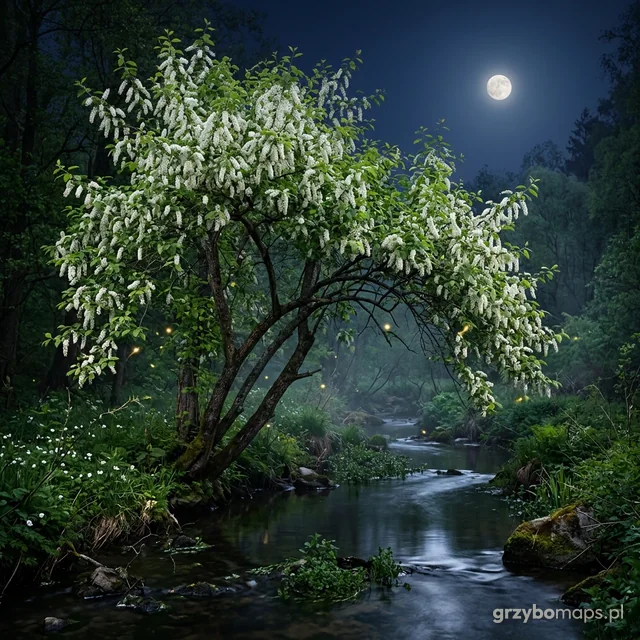
A shrub or small tree of damp forests and riverbanks. In May it is covered with hanging clusters of white, strongly scented flowers. Its leaves are often entangled in the web of ermine moth caterpillars.
How to recognise
- Bark dark grey, smooth, with an unpleasant, bitterish smell when scraped.
- Leaves elliptical, finely serrated, with two glands on the leaf stalk.
- Flowers white in long, hanging clusters; fruits small, round, black, shiny.
- Often a multi-stemmed shrub or a tree up to 15 m.
Where it lives
Throughout Poland, in floodplain forests, alder carrs, along rivers and streams.
Fruits and seeds
The flesh of ripe fruits is astringent but edible after processing. The stones, leaves and bark contain glycosides from which hydrogen cyanide is formed, so the stones must not be cracked or eaten.
In the past
Fruits were formerly used for homemade liqueurs and juices, the wood for small joinery items.
Fun fact
In some years the caterpillars of the bird-cherry ermine moth wrap whole shrubs in silvery silk, making them look covered in cobweb. The shrub usually recovers afterwards.