

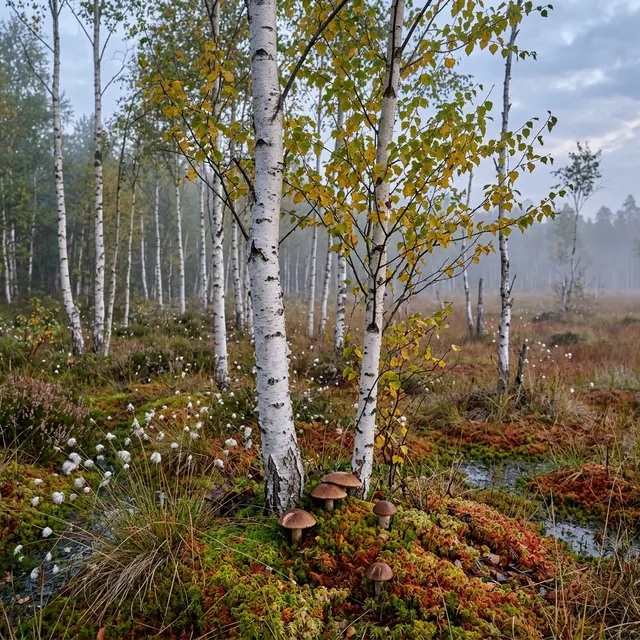
Downy birch
Betula pubescens
A close relative of the silver birch, tied to wet habitats: peat bogs, alder carrs and boggy birch woods. It is common throughout the lowlands. Important for the forager, because bolete mushrooms grow under birches on peat bogs.
How to recognise
- Young shoots softly hairy, without resin warts or with only a few.
- Leaves ovate or rhombic, without a drawn-out tip, with tufts of yellowish-grey hairs in the vein angles on the underside.
- Bark of young trees violet-red, later matt white, peeling in circular strips.
- Branches upright or horizontal, the shoots do not hang down as in the silver birch.
Where it lives
Common throughout the lowlands, rare in the mountains. Peat bogs, swamp forests, alder carrs, damp acidic oak woods and willow thickets.
Fruits and seeds
The fruits are tiny winged nutlets and are not food for people. Birch leaves are a herbal raw material, but this is not advice. In spring it yields sap just like the silver birch (harvesting is described in the Herbal under birch sap).
Which mushrooms grow under it
- brown birch bolete
- koźlarz torfowiskowy (under birches on peat bogs)
- woolly milkcap (poisonous)
- fly agaric (poisonous)
- birch polypore (razor strop fungus)
- błyskoporek podkorowy (protected)
In the past
Birch leaf (from silver and downy birch) is a herbal raw material with a diuretic effect. It avoids dry places and is frost-hardy, growing well on waterlogged, acidic soils.
Fun fact
It readily crosses with the silver birch, and the hybrids have intermediate features, so they are hard to recognise. In the Alps it grows up to 2000 m above sea level.