

Black elder
Sambucus nigra
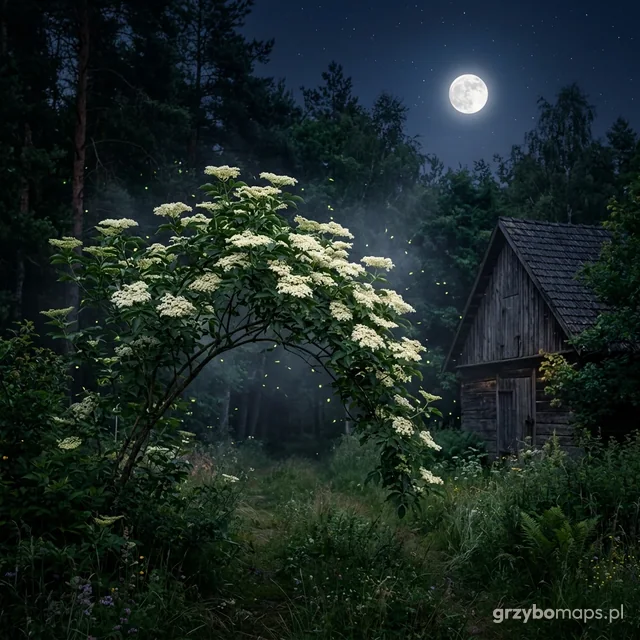
A fast-growing shrub or small tree that likes fertile, nitrogen-rich soils near houses and at forest edges. In June it is fragrant with creamy-white umbels of flowers. Its branches have a soft white pith inside.
How to recognise
- Bark grey-brown, corky, with warty lenticels.
- Leaves odd-pinnate with 5 to 7 serrated leaflets, with an unpleasant smell when crushed.
- Flowers creamy-white in large, flat umbels; fruits blackish-purple, small, on reddish stalks.
- Shoots with a thick, white, spongy pith.
Where it lives
Throughout Poland, at forest edges, in floodplain forests, thickets, near houses and ruins.
Fruits and seeds
Raw fruits, especially unripe ones, as well as the leaves and bark, can cause nausea, vomiting and diarrhoea. Ripe fruits are eaten only after cooking (juices, jams). Do not confuse it with dwarf elder, a poisonous perennial with similar flowers and fruits.
Which mushrooms grow under it
- uszak bzowy
In the past
Flowers for syrups and infusions, fruits after cooking for juices. Whistles and pipes were made from the shoots after removing the pith.
What the beliefs say
In folk beliefs a black elder bush was not to be dug up or destroyed without need, because that was said to bring misfortune.
Fun fact
On old elder branches grows the jelly ear, a gelatinous, ear-shaped fungus. It is edible and prized in Asian cuisine.