

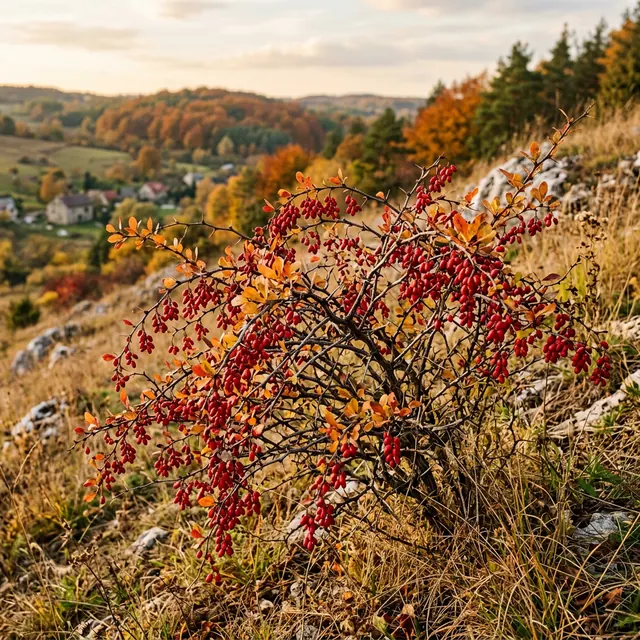
Common barberry
Berberis vulgaris
A thorny shrub with yellow flowers and red, sour fruits. It used to be common on field boundaries and forest edges, but farmers eradicated it because it hosts cereal rust. It grows on sunny slopes and in thickets, preferring limestone soils.
How to recognise
- A shrub up to 3 m with angular twigs and three-pronged thorns.
- Leaves 3 to 6 cm, finely spiny-toothed, in clusters on short shoots.
- Flowers yellow, fragrant, in hanging clusters up to 5 cm, flowering in May and June.
- Fruits oblong, glossy red, sour berries, ripening in September and October.
Where it lives
Formerly common throughout Poland. Sunny hills, thickets, light-filled forests, fertile limestone and clay soils.
Fruits and seeds
Ripe fruits are edible and sour; juices and preserves are made from them. The bark and roots contain alkaloids, mainly berberine, which accumulates in the heart, liver and pancreas, so barberry products must not be consumed for long. Do not use the bark or roots on your own.
Which mushrooms grow under it
- cereal rust (its spring generation develops on the leaves)
- Erysiphe berberidis (powdery mildew)
In the past
An ornamental plant and a former medicinal plant. The fruits are used for juices, syrups, jams, preserves and for drying.
Fun fact
Part of the life cycle of cereal rust, a dangerous cereal disease, takes place on barberry. That is why it used to be cut down near fields.