

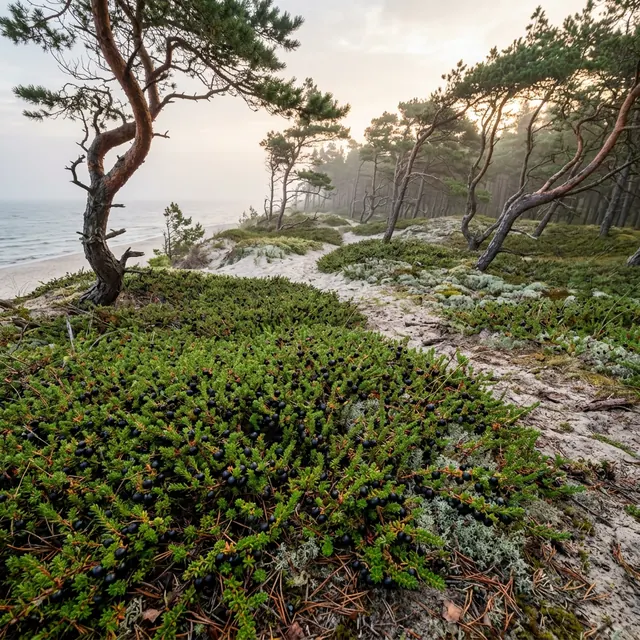
Black crowberry
Empetrum nigrum
A low, evergreen subshrub with needle-like leaves and black, glossy fruits. In Poland it grows mainly by the sea in crowberry pine forests and on peat bogs, as well as in the Sudetes and Carpathians. It is partially protected.
How to recognise
- Shoots limp, branched, creeping, up to about 1 m long; the plant up to 50 cm tall.
- Leaves 4 to 5 mm, narrow, leathery and glossy, with margins so rolled under that only a white line is visible beneath.
- Flowers small, pink or red, in the leaf axils, from the end of March to May.
- Fruits spherical, black, juicy, 7 to 8 mm in diameter, ripening from August to October.
Where it lives
Baltic coast and lakelands of northern Poland, sparse in the North Podlasie Lowland; in the mountains in the Sudetes and Carpathians. Crowberry pine forest on coastal dunes, peat bogs.
Fruits and seeds
The fruits are edible, but bland and watery; eaten in excess they are said to cause constipation. The herb (shoots and leaves) has been found to contain the poisonous grayanotoxin, so do not prepare infusions from it. Crowberry is protected.
Which mushrooms grow under it
- ericoid mycorrhizal fungi, including those of the genus Oidiodendron (no Polish names)
In the past
Fruits edible. In the past the juice with alum was used to dye linen, wool and furs dark red. A ground-cover plant.
Fun fact
Crowberry subshrubs are long-lived: the oldest shoots studied were 140 years old. The fruits have very high antioxidant activity, similar to chokeberry.