

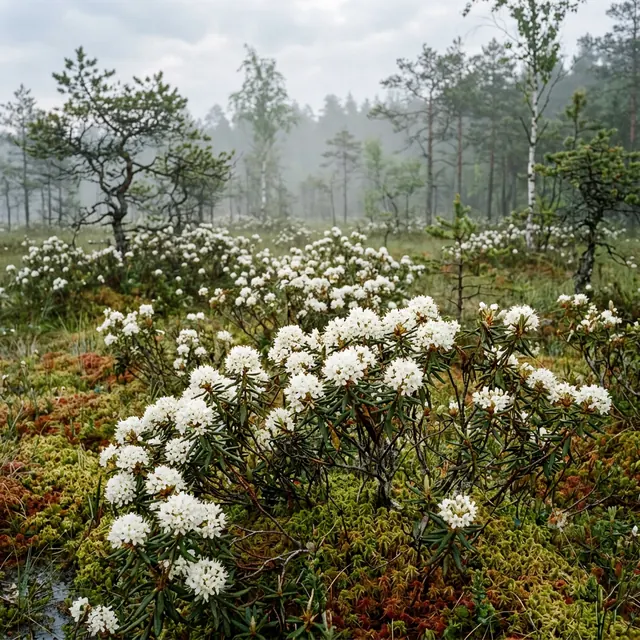
Marsh Labrador tea
Rhododendron tomentosum
An evergreen, strongly scented shrub of peat bogs and boggy pine forests. The whole plant is poisonous. In Poland it is partially protected.
How to recognise
- A shrub usually 0.5 to 1 m tall, young shoots densely covered with rusty hairs.
- Leaves leathery, narrow, up to 5 cm, dark green and glossy above, with rusty felt beneath, margins rolled under.
- Flowers white, five-petalled, gathered in umbels at the tips of the shoots, flowering in May and June.
- A strong, characteristic smell from the whole plant.
Where it lives
Throughout the lowlands, rare in Kuyavia and Greater Poland. Rare in the mountains, most common on the peat bogs of the Orava-Nowy Targ Basin, in the Tatras up to 1350 m above sea level. Raised bogs, boggy pine forests and birch woods.
Fruits and seeds
The fruits are dry capsules, inedible. The whole plant is poisonous: the oil containing ledol strongly irritates the stomach and intestines, causes vomiting and affects the nervous system. The pollen and honey from its flowers are also poisonous. The pollen of marsh Labrador tea is considered the cause of dizziness and vomiting after eating the bog bilberries growing next to it.
Which mushrooms grow under it
- Chrysomyxa ledi (rust of spruce and marsh Labrador tea, alternates between spruce and marsh Labrador tea)
In the past
In the past the herb was put in houses against moths, which caused accidental poisonings of children. It was also added to beer, which led to poisonings.
Fun fact
The marsh Labrador tea used to be placed in a separate genus, Ledum, but it turned out to belong to the rhododendrons. That is why it is now called Rhododendron tomentosum.