

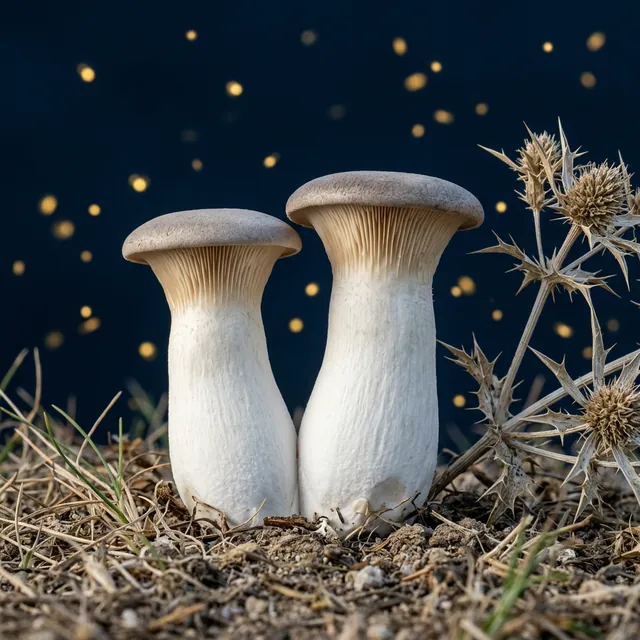
King trumpet mushroom
Pleurotus eryngii
Polish folk names: boczniak królewski, king oyster
How to recognise
- Cap 4–12 cm, flat or slightly funnel-shaped, grey-brown to light brown, smooth.
- Gills whitish to cream, running far down the stem.
- Stem thick, up to 10 cm, white, fleshy and firm, usually central or slightly off-centre.
- Flesh white, compact, does not darken; pleasant mushroomy smell.
Where and when it grows
In the wild it grows in dry meadows and pastures of the Mediterranean basin, on the dead roots of eryngo. In Poland it practically does not occur in the wild. Known from farms and shops all year round.
JanFebMarAprMayJunJulAugSepOctNovDec
Most often under: in the wild on the roots of sea holly in dry meadows of southern Europe; in Poland only from cultivation.
Beware of the lookalike
Oyster mushroom. The oyster mushroom grows in overlapping tiers on trunks and has a short, lateral stem. The king trumpet mushroom has a thick, central stem and grows singly. Both are edible.
In the kitchen
Cut the stem into thick slices and sear it like scallops, or grill it. Sliced into strips, it resembles meat in dishes. It also works in soups and stir-fries.
Good to know
You won't find it in Polish meadows. In shops it is sold as king trumpet mushroom, and in Asian cooking as king oyster. Always eat it cooked.
Frequently asked questions
Is king trumpet mushroom edible?
Yes, king trumpet mushroom is an edible mushroom.
King trumpet mushroom: what is it easily confused with?
Most often with the species Oyster mushroom. The oyster mushroom grows in overlapping tiers on trunks and has a short, lateral stem. The king trumpet mushroom has a thick, central stem and grows singly. Both are edible.