

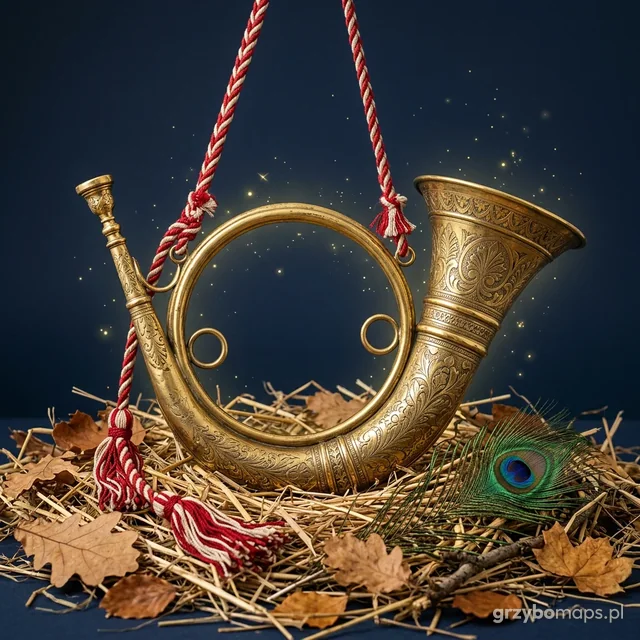
The Golden Horn
Polish literature (“The Wedding” by Wyspiański)
This is how it looks in your profile
This artefact is waiting somewhere in the forest. When you find it while mushroom picking, its animated icon will light up in your Trophies, in the Artefact Display Case. Rare artefact gives 15 pts in the league.
In Stanisław Wyspiański’s “The Wedding” (“Wesele”), Wernyhora gives the Host a golden horn whose sound is meant to rouse the nation to battle. Jasiek loses it when he bends down for his cap with peacock feathers.
Origin
The golden horn is a literary object from the drama “Wesele” (The Wedding) by Stanisław Wyspiański, first staged at the Municipal Theatre in Kraków on 16 March 1901. The inspiration was the real wedding of the poet Lucjan Rydel to the peasant girl Jadwiga Mikołajczykówna in Bronowice near Kraków in November 1900.
History
A wedding night in a cottage in Bronowice. Intellectuals from Kraków dance with peasants, talk about Poland, about poetry and about how the people and the gentlemen should at last stand together. As the festivities go on, the persons of the drama begin to come into the room: figures from the past, spectres and apparitions, summoned by the words of the wedding guests themselves.
The most important of the guests is Wernyhora, the legendary Ukrainian lyre player and seer who, according to tradition, foretold the fall and rebirth of Poland. He comes to the Host and hands him a golden horn. At dawn he must blow it, call the people together and set out, and then the nation will rise. In doing so Wernyhora loses a golden horseshoe, which the Hostess hides in a chest.
The Host, tired and slightly drunk, passes the horn to the farmhand Jasiek and tells him to ride round the villages and summon the people. Jasiek races off, but on the way he bends down for a fallen cap with peacock feathers. At that moment the horn slips from his hands and is lost.
At dawn everyone waits with scythes and listens. Jasiek returns empty-handed, and the Chochoł, a straw effigy wrapped round a rose bush for the winter, plays the fiddle and tells the wedding guests to dance in an enchanted circle. The famous words ring out: “You had, you lout, a golden horn, you had, you lout, a cap of feathers: the wind carries off the cap, the horn booms through the forest, only the cord is left to you.”
How it works
In the play the horn works only if it is sounded at dawn, and at its call everyone is to stand ready for action. When Jasiek returns without the horn, the Straw Man orders the wedding guests to dance in an enchanted circle, and no one sets out to fight.
Powers
- Awakening of the nation: According to Wernyhora, the sound of the horn is to rouse everyone to action and unite the people with the gentlemen.
- Condition of dawn: It must be blown at dawn, at the appointed moment, otherwise the chance is lost.
- Test of character: The horn works only in the hands of someone who does not let trifles distract him, such as a cap of peacock feathers.
- Enchanted circle: When the horn is lost, the Chochoł shuts everyone into a sleepy dance from which no one can break free.
Fate
The horn “booms through the forest”, and so in the drama it is lost for ever. For more than a hundred years it has been a symbol in Polish of a great wasted opportunity, and the phrase “only the cord is left to you” has become a proverb.
In culture
In 1972 Andrzej Wajda made the film “Wesele” (The Wedding) based on the drama. “Wesele” is a school reading, and the golden horn and the Chochoł are among the most frequently invoked symbols in Polish culture.
Fun fact
The world premiere of “The Wedding” took place in Kraków in 1901 and caused a huge stir. The golden horn became a symbol of a wasted opportunity, and the feathered cap a symbol of chasing trifles.