

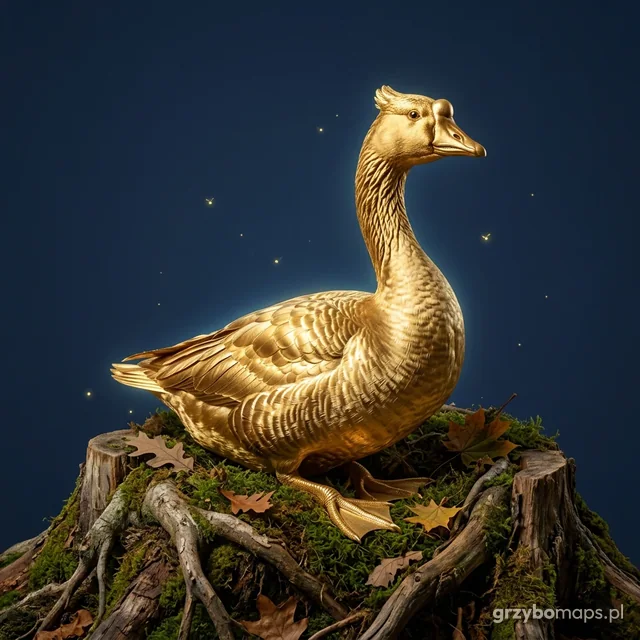
The Golden Goose
fairy tale (Brothers Grimm)
This is how it looks in your profile
This artefact is waiting somewhere in the forest. When you find it while mushroom picking, its animated icon will light up in your Trophies, in the Artefact Display Case. Rare artefact gives 15 pts in the league.
A goose with feathers of pure gold from the Brothers Grimm fairy tale “The Golden Goose” (1812). The youngest son, called Dummling, shared his food with a little grey man and as a reward found it among the roots of a felled tree.
Origin
The golden goose comes from the Brothers Grimm tale “The Golden Goose” (no. 64 in their collection), published in 1812 in the collection “Children’s and Household Tales”. It belongs to type 571 in the ATU tale-type catalogue, in which everyone sticks to a single object and forms a funny procession that makes a sad princess laugh.
History
A man has three sons, and everyone despises the youngest and calls him Simpleton. The eldest goes into the forest to chop wood, with cake and wine from his mother. He meets a little grey man who asks for a bite and a sip, but he refuses, and a moment later he cuts his hand with the axe. The same happens to the middle one, who wounds his leg.
Simpleton gets only a cake baked in the ashes and sour beer, but he shares with the little man without hesitation. Then his cake turns into a splendid pastry and the beer into good wine. As a reward the little man tells him to cut down an old tree, and in its roots the boy finds a goose with feathers of pure gold.
Simpleton spends the night with the goose at an inn. The innkeeper's three daughters each want to pull out at least one golden feather, and each sticks to the goose or to her sister. In the morning the boy sets off, paying no heed to the girls trailing behind him. Whoever tries to pull them away sticks to the procession: a parish priest, a sexton and two villagers with hoes.
So they arrive at a city where lives a princess so sad that no one has managed to make her laugh. At the sight of the strange procession she bursts out laughing. The king, however, does not want to give up his daughter and devises trials: to find a man who will drink a cellar of wine, one who will eat a mountain of bread, and a ship that sails on land and on water. Each time the little grey man helps, and Simpleton marries the princess and inherits the kingdom.
How it works
Whoever touches the goose sticks to it, and whoever touches the one stuck to it sticks to him in turn. So a whole procession followed Dummling: the innkeeper’s daughters, the parson, the sexton and the peasants. At the sight of it the princess, who had never laughed, burst out laughing.
Powers
- Sticking thieves: Whoever touches the goose sticks to it and cannot pull away, and whoever touches the one who is stuck also sticks.
- Procession of laughter: The line of people trailing behind the goose is so funny that it made the princess, who had never laughed, laugh.
- Golden feathers: The feathers are of pure gold, which tempts everyone who sees her.
- Reward for kindness: The goose goes only to the one who shared his food with a stranger.
Fate
The tale does not say what happened to the goose after Simpleton's wedding; it ends with his reign and a happy life. The motif of people sticking to a magical object also appears in tales from other European countries.
In culture
In Poland the tale is known from translations of the Grimms under the title “Złota gęś” (The Golden Goose), and its motif returns in many puppet theatre productions. It should not be confused with Aesop's fable about the goose that lays golden eggs.
Fun fact
The tale is number 64 in the Grimms’ collection. After the princess was made to laugh, the king kept inventing new trials for Dummling, and in each one the little grey man helped him.