

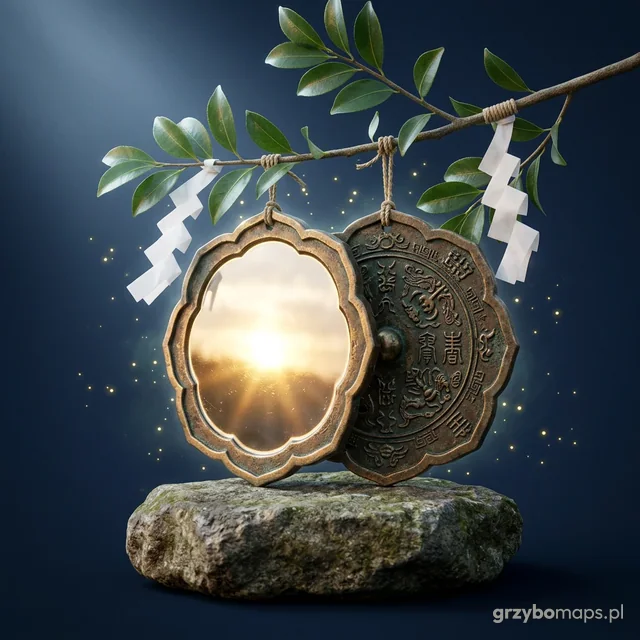
Yata no Kagami
Japanese mythology
This is how it looks in your profile
This artefact is waiting somewhere in the forest. When you find it while mushroom picking, its animated icon will light up in your Trophies, in the Artefact Display Case. Common artefact gives 5 pts in the league.
The sacred eight-sided mirror, one of the three Imperial Regalia of Japan. According to the myth, it was made to lure the sun goddess Amaterasu out of the cave in which she had hidden herself and plunged the world into darkness.
Origin
The myth of the mirror is described in the chronicles “Kojiki” (712) and “Nihon shoki” (720). It was made by Ishikoridome, the god of smiths, when the gods had to lure the sun goddess Amaterasu out of a cave.
History
The storm god Susanoo raged in the heavens: he destroyed the rice fields of his sister Amaterasu, and finally threw a flayed horse through a hole in the roof into her sacred weaving hall. The terrified goddess hid in the Heavenly Rock Cave, Ama no Iwato, and closed the entrance with a stone. The world sank into darkness, and evil spirits ran rampant everywhere.
Eight hundred myriads of gods gathered by the Heavenly River. The wise god Omoikane devised a plan. Ishikoridome forged the mirror, Tamanoya strung a cord of magatama jewels, and both treasures were hung on a sakaki tree in front of the cave. Roosters were gathered so that they would crow as at dawn.
The goddess Ame no Uzume leapt onto an overturned tub and danced so wildly that the gods burst into roaring laughter. Curious, Amaterasu moved the stone aside a little and asked what they were rejoicing about when the world was dark. She was told that a goddess more splendid than herself had arrived, and she saw her own radiance in the mirror.
As she leaned out further, the strong god Ame no Tajikarao seized her by the hand and pulled her out of the cave, and a sacred rope was stretched behind her so that she could no longer return. The sun came back to the world. Amaterasu later passed the mirror to her grandson Ninigi with the words that he should look upon it as upon her own self.
For centuries the mirror was kept in the imperial palace. According to the “Nihon shoki”, Emperor Sujin decided that it was not fitting to live under one roof with such a sacred object. Princess Yamatohime wandered with it around the country for a long time, until the goddess showed her Ise as the place where it was to stay.
How it works
The gods hung the mirror on a tree in front of the cave. When Amaterasu peeked out, curious, she saw her own radiance in it, and then she was drawn outside and light returned to the world. The mirror symbolises wisdom and honesty.
Powers
- Reflection of the sun: The mirror drew Amaterasu out with her own radiance and brought light back to the world.
- Presence of the goddess: According to the myth, Amaterasu commanded that the mirror be looked upon as upon herself.
- Wisdom and truth: Among the imperial treasures, the mirror symbolises wisdom and sincerity.
- Right to the throne: Together with the sword and the jewel it confirms the divine descent of the emperors.
Fate
The mirror rests in the Inner Shrine (Naikū) of the Ise Grand Shrine, wrapped and hidden in a chest. No one, not even the emperor, views it publicly, and a copy of it is kept in the Kashiko-dokoro sanctuary in the Imperial Palace in Tokyo.
In culture
The myth of the Ama no Iwato cave is depicted in kagura dances and in ukiyo-e woodblock prints, and in the game “Ōkami” the mirror is the weapon of the sun goddess.
Fun fact
The mirror is kept in the Grand Shrine of Ise and is never shown publicly.