

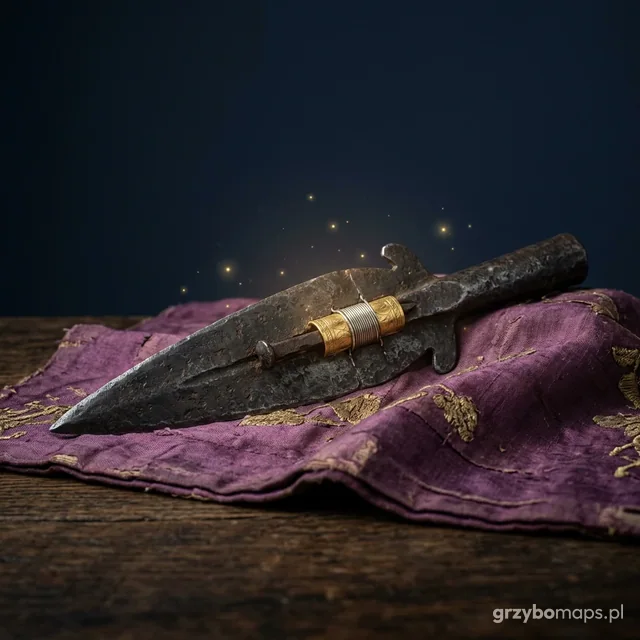
The Spear of Destiny
Christian tradition
This is how it looks in your profile
This artefact is waiting somewhere in the forest. When you find it while mushroom picking, its animated icon will light up in your Trophies, in the Artefact Display Case. Legendary artefact gives 50 pts in the league.
The spear with which, according to the Gospel of St John, a soldier pierced the side of the crucified Jesus. Tradition gave this soldier the name Longinus, and surrounded the spear with veneration as a relic of the Passion of the Lord.
Origin
Its source is the Gospel of John (19:34), which describes how one of the soldiers pierced the side of the crucified Jesus with a spear, and blood and water flowed out. The name Longinus was given to him by the apocryphal Gospel of Nicodemus, and the cult of the relic is attested by pilgrims to Jerusalem from the 6th century onwards.
History
According to tradition, the centurion Longinus was almost blind. When he pierced Christ's side, a drop of blood ran down onto his eyes and he regained his sight. He converted, gave up military service and, according to legend, died a martyr's death in Cappadocia. The Church venerates him as a saint.
Pilgrims in the 6th century described a spear venerated in Jerusalem. When the Persians captured the city in 614, the spearhead was, according to accounts, broken off and taken to Constantinople, where it joined the imperial collection of relics. The later spears in Rome and Paris derive from this source.
In 1098 the crusaders besieged in Antioch were close to defeat. A simple pilgrim, Peter Bartholomew, announced that St. Andrew had appeared to him in a dream and shown him where the Lance was hidden. A spearhead was found beneath the floor of the cathedral, and the heartened knights defeated the army of Kerbogha. Many, however, doubted the find, and Peter, subjected to an ordeal by fire, died soon afterwards.
The most famous is the Holy Lance of the German emperors, forged in the Carolingian era, with a nail that tradition regarded as a nail from the Cross set into the spearhead. According to the chronicles, Otto I had it with him in the victorious battle against the Lech in 955. It was also identified with the spear of St. Maurice, patron saint of knighthood.
For Poland the most important year is 1000. During the Congress of Gniezno, Emperor Otto III gave Bolesław the Brave a copy of his Lance, as a sign of friendship and recognition. This spear has survived to this day.
How it works
Medieval tradition regarded the spear as a sign of God's protection over the ruler: emperors carried it before the army as a relic. A legend also says that Longinus, almost blind, regained his sight when the blood of Christ touched him, and was converted.
Powers
- Healing of Longinus: According to legend, Christ's blood restored the sight of the soldier who pierced His side.
- Sign of protection over the ruler: In the Middle Ages it was believed that a relic carried before the army secured God's support for the ruler.
- Courage in battle: Chroniclers describe how the finding of the lance in Antioch gave the crusaders spirit for the victorious fight.
- Sign of power: Handing over a copy of the spear meant recognition of dignity and friendship, as in Gniezno in 1000.
Fate
Several relics are considered to be the Lance of Longinus. The Carolingian spear lies in the Imperial Treasury in Vienna, the spearhead kept in St. Peter's Basilica in Rome was given to the Pope by Sultan Bayezid II in 1492, and in Armenia, in Echmiadzin, a spear called Geghard is venerated. The Polish copy from the year 1000 rests in the Treasury of Wawel Cathedral.
In culture
The holy lance is one of the main motifs of Richard Wagner's opera “Parsifal” of 1882. The Polish spear from Wawel is sometimes shown in illustrations of the Congress of Gniezno.
Fun fact
The most famous of the spears, the Carolingian Holy Lance with a nail set into the spearhead, lies in the Imperial Treasury in the Hofburg in Vienna. Otto III presented a copy of it to Bolesław the Brave in the year 1000, and it is kept today in Wawel Cathedral.