

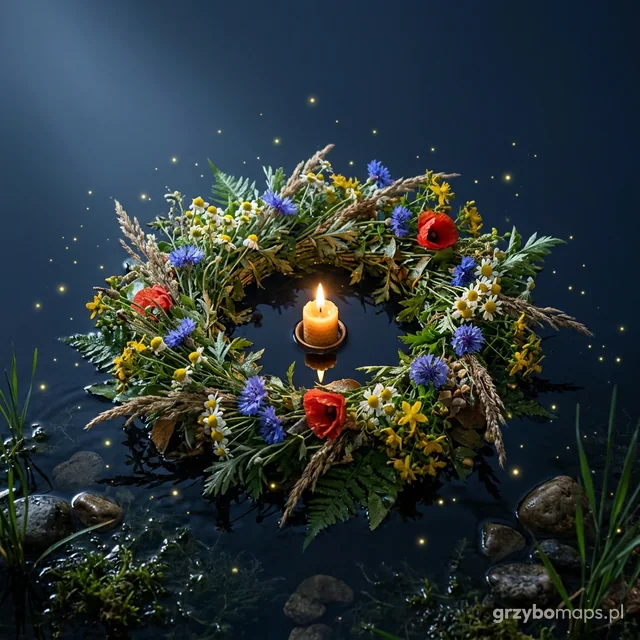
Wreath from Kupala Night
Slavic rites
This is how it looks in your profile
This artefact is waiting somewhere in the forest. When you find it while mushroom picking, its animated icon will light up in your Trophies, in the Artefact Display Case. Common artefact gives 5 pts in the league.
On the shortest night of the year, girls wove wreaths of herbs and flowers, put a lit candle in them and set them afloat on the water. The custom survives to this day in the Midsummer “Wianki”.
Origin
The wreaths floated on water are part of the rites of Kupala Night, the summer solstice festival celebrated by the Slavs on the shortest night of the year. Christianity linked it with the eve of St John the Baptist (23 June), and in Poland it was already described by Jan Kochanowski in the “Song of St John’s Eve” (“Pieśń świętojańska o Sobótce”, published 1586).
History
On the evening before the shortest night of the year, girls went to the meadows and gathered herbs which were then believed to have the greatest power: mugwort, St John’s wort, known as the St John’s herb, chamomile, wild thyme and wildflowers. From them they wove wreaths, braiding in ribbons, and often also a lit candle or a splinter torch.
When the Sobótka bonfires blazed on the hills and the young people leapt over the fire, the maidens went down to the river. Each set her wreath on the water and watched what became of it. The lads waited downstream, sometimes in boats, sometimes swimming, to fish out the wreath of the one they fancied. Whoever fished out a wreath had a right to her attention, and sometimes it was the beginning of courtship.
People foretold the future from the behavior of the wreath. If it floated fast and far, it announced a speedy wedding and happiness. If it circled in place or washed up on the bank, it meant spinsterhood for another year. If it sank or the candle went out, it foretold misfortune, even death. If two wreaths floated together, the maidens were to be close friends for a long time.
In the “Song of St John’s Eve” Kochanowski gave a voice to twelve maidens who, by the Sobótka fire at Czarnolas, sing songs in turn about love, work and country life. For centuries the Church tried to eradicate the old customs, but the wreaths survived, because they had permanently grown together with St John’s Day.
How it works
The wreath was a divination: if it drifted far away, it foretold happiness and a swift wedding, and if it kept turning in place, spinsterhood. A wreath that sank foretold misfortune. The boys would jump into the water to fish out the wreath of the girl they had chosen.
Powers
- Love divination: According to custom, the wreath’s course on the water foretold whether the maiden would soon marry.
- Choosing a sweetheart: The lad who fished out the wreath was said to be destined for its owner.
- The power of herbs: It was believed that herbs gathered on St John’s night protect against disease, spells and lightning.
- A warning from fate: A wreath sinking or a candle going out foretold misfortune.
Fate
Individual wreaths drift away with the current every year, but the custom has never died out. Today “Wianki” are big city festivals, including in Kraków beneath Wawel and in Warsaw on the Vistula, combined with concerts and fireworks displays.
In culture
Kochanowski’s “Song of St John’s Eve” is the most famous Old Polish description of Kupala. The Kraków Wianki on the Vistula have been held as a city event since 1992.
Fun fact
Jan Kochanowski described the midsummer rites in his “Midsummer Song of Saint John's Eve”. Every year Kraków holds the Wianki on the Vistula beneath Wawel Castle, as a city event since 1992.