

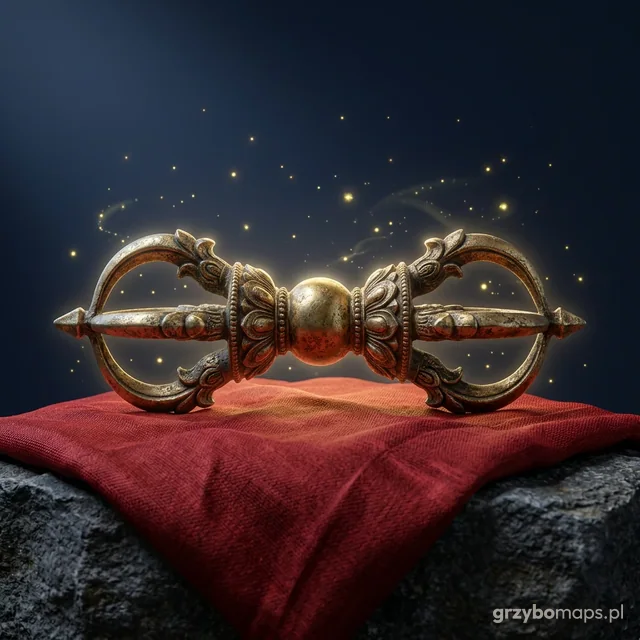
Vajra
Hinduism and Buddhism
This is how it looks in your profile
This artefact is waiting somewhere in the forest. When you find it while mushroom picking, its animated icon will light up in your Trophies, in the Artefact Display Case. Common artefact gives 5 pts in the league.
The thunderbolt of the god Indra, and in Tibetan Buddhism also a ritual object called the dorje. It has the shape of a short sceptre with forked, closed ends.
Origin
The vajra appears as early as the “Rigveda”, the oldest collection of Indian hymns (c. 1500 to 1000 years before Christ), as the weapon of the god Indra. The word means both “thunderbolt” and “diamond”, which conveys its power and indestructibility.
History
The hymns of the “Rigveda” tell of the serpent Vritra, who blocked the rivers and imprisoned the waters in the mountains. The world withered without rain. Indra, strengthened by the drink soma, seized the thunderbolt forged by the divine smith Tvashtar and struck the dragon, and the released waters flowed to the sea.
Later Puranic stories add a moving tale. When the gods could not defeat Vritra, they learned that a weapon able to defeat him could be made only from the bones of the sage Dadhichi. Dadhichi willingly gave up his life, and a new vajra was forged from his bones. In Hinduism this is a model of selflessness for the good of others.
Buddhism took over the vajra and gave it a new meaning. The bodhisattva Vajrapani, “Holder of the Vajra”, protects the Buddha and his teaching. The vajra became a symbol of diamond-hard enlightenment, which no illusion can destroy. From it comes the name of the “Diamond Sutra”, in Sanskrit “Vajracchedika”.
In Tibetan Buddhism the vajra is called dorje. During rituals the lama holds it in the right hand as a sign of method and compassion, and in the left a bell, the ghanta, signifying wisdom. Together they represent the unity of these two paths to enlightenment.
Tradition links the vajra with Padmasambhava, the master who, according to Tibetan accounts, in the 8th century defeated local demons and helped to root Buddhism in Tibet. In his images he often holds a vajra in his right hand.
How it works
In the Vedas the vajra was forged by the divine smith Tvashtar, and with it Indra defeated the serpent Vritra and released the waters. In Buddhism it signifies the indestructibility of enlightenment: a lama holds it in his right hand, and a bell in his left.
Powers
- Thunderbolt of the gods: In the Vedas the vajra is Indra’s weapon, with which he defeated the serpent Vritra.
- Release of the waters: The strike of the vajra broke Vritra’s dam and restored rivers and rain to the world.
- Indestructibility: As a “diamond” it cannot be broken, just like the truth of enlightenment.
- Protection against evil: In Buddhism it drives away obstacles and evil powers.
- Unity with compassion: In ritual, paired with the bell, it symbolizes the union of method and wisdom.
Fate
The vajra is used today in the rites of Tibetan Buddhism in the Himalayas and around the world. The name of the city of Darjeeling is sometimes derived from the Tibetan Dorje Ling, “place of the thunderbolt”, and images of the vajra adorn coats of arms and flags, including the emblem of Bhutan.
In culture
Indra with the vajra is a frequent motif in Indian art, and Vajrapani appears already in sculptures from Gandhara. The vajra was the symbol of India’s highest military decoration, the Param Vir Chakra.
Fun fact
The name of Vajrayana, that is, Tibetan Buddhism, often called the “Diamond Vehicle”, comes from the vajra.