

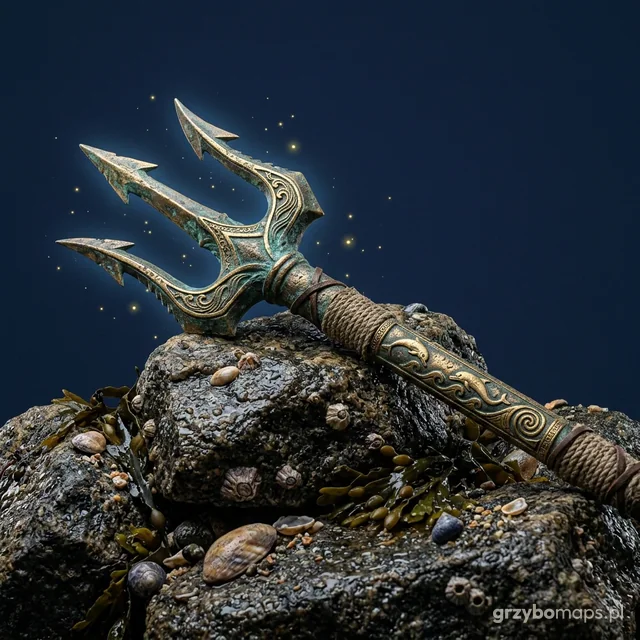
Trident of Poseidon
mitologia grecka
This is how it looks in your profile
This artefact is waiting somewhere in the forest. When you find it while mushroom picking, its animated icon will light up in your Trophies, in the Artefact Display Case. Legendary artefact gives 50 pts in the league.
The trident of Poseidon, ruler of the seas, forged by the Cyclopes during the war of the gods against the Titans. It was at once a weapon, a sceptre and a fisherman’s tool.
Origin
The trident, in Greek triaina, was forged, according to Apollodorus, by the Cyclopes during the war with the Titans, together with Zeus’s thunderbolt and Hades’s helm. Homer in the “Odyssey” shows Poseidon stirring up the sea with his trident and shattering rocks, and the dispute over Athens was described by, among others, Herodotus in the 5th century BC.
History
After the victory over the Titans the three brothers drew lots to decide what each would rule. The sky fell to Zeus, the underworld to Hades, and the sea to Poseidon, with the trident as a sign of his power. He lived in a golden palace in the depths near Aigai and rode over the waves in a chariot drawn by horses with bronze hooves.
Poseidon willingly fought for land. In the dispute over Attica he struck the rock of the Acropolis with his trident and brought forth a salt spring, a “sea”, while Athena planted an olive tree. The judges, depending on the version the gods or King Cecrops, awarded the city to Athena. The angry Poseidon then flooded the plain of Eleusis. He lost a similar dispute with Hera over Argolis and in revenge dried up the rivers there.
The trident could also give water. When the Danaid Amymone was searching for a spring in the parched land of Argos, Poseidon saved her from a satyr, then struck a rock with his trident and the springs of Lerna gushed forth. In another story, about Thessaly, a strike of the trident on a rock created the first horse, which is why Poseidon was also lord of horses.
The trident was most dangerous when wielded in anger. In the “Odyssey” Ajax, son of Oileus, boasted that he had survived the storm against the gods’ will. Poseidon then seized his trident and split the rock on which Ajax sat, and he drowned. With the same trident the god gathered the clouds and stirred up the sea, smashing the raft of Odysseus, who had blinded his son, the Cyclops Polyphemus.
How it works
According to the myths, when Poseidon strikes the ground with his trident, an earthquake comes and springs gush forth. With one movement he can whip up the sea or calm it. In the contest over Athens he struck the rock of the Acropolis with it and brought forth a salt spring, but the city chose Athena’s gift, the olive tree.
Powers
- Earthquake: A strike of the trident on the ground causes tremors, hence Poseidon’s epithet Enosichthon, “earth-shaker”.
- Dominion over the sea: The trident stirs up the waves or calms them with a single movement.
- Springs from rock: A stone struck with it releases a spring, salt or fresh.
- Shattering rocks: With a single blow it shatters a rock or a mountain.
Fate
The trident stayed with Poseidon and, among the Romans, with Neptune. Marks regarded as its imprint in the rock are still shown today in the Erechtheion on the Acropolis, and the symbol itself found its way into coats of arms and flags, e.g. a broken trident appears on the flag of Barbados.
In culture
In Gdańsk, since 1633, the Neptune Fountain with a statue of the god holding a trident has stood on the Long Market, one of the symbols of the city. Poseidon’s trident is also an important object in, among others, the film “Pirates of the Caribbean: Dead Men Tell No Tales” (2017).
Fun fact
The Greek traveller Pausanias in the 2nd century AD described the imprint of a trident in the rock on the Acropolis. Marks regarded as that imprint are still shown today in the Erechtheion.