

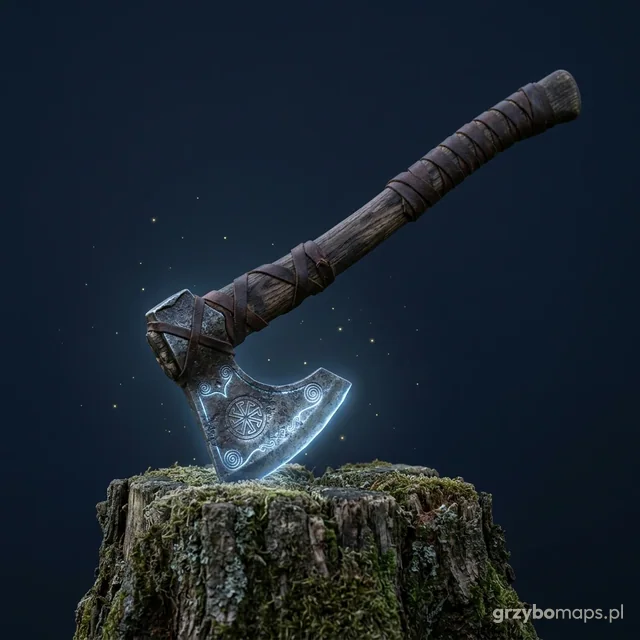
Axe of Perun
Slavic mythology
This is how it looks in your profile
This artefact is waiting somewhere in the forest. When you find it while mushroom picking, its animated icon will light up in your Trophies, in the Artefact Display Case. Rare artefact gives 15 pts in the league.
Perun was the Slavic god of lightning, thunder and war, and his name survives in the Polish word “piorun” (thunderbolt). He was usually depicted armed with an axe, hammer or spear, fighting the demons of chaos.
Origin
Perun was the most important god of the Eastern Slavs, lord of thunder, storm and war. As early as the 6th century the Byzantine historian Procopius of Caesarea wrote that the Slavs worship one god, the maker of lightning, and sacrifice oxen to him, and the name of Perun is mentioned in the Rus’ “Primary Chronicle” from the early 12th century.
History
According to the reconstructions of researchers, especially Vyacheslav Ivanov and Vladimir Toporov, the myth of Perun told of a great war between sky and earth. Perun lived at the top of the world, in the crown of a mighty oak, and at its roots lurked Veles, lord of the underworld, waters and cattle. When Veles stole his cattle, wife or child, Perun set out in pursuit.
Veles fled, transforming himself into a snake, a man, a tree or a stone, and Perun hurled thunderbolts at each of his hiding places. That is why, as people believed, lightning strikes lone trees and boulders. In the end the god of storms killed his opponent or cast him into the waters, and life-giving rain fell from the sky. Every storm was an echo of this fight.
The Rus’ truly believed in Perun. The chronicle describes that in the treaties with Byzantium of 907 and 945 the prince’s warriors swore an oath on Perun, laying their swords and shields before them. In 980 Prince Vladimir set up on a hill in Kyiv a wooden statue of Perun with a silver head and golden mustache.
A few years later, after the baptism of the Rus’, the same Vladimir ordered the statue to be toppled. According to the chronicle it was tied to a horse’s tail, dragged to the Dnieper, beaten with sticks and thrown into the river. Perun suffered a similar fate in Novgorod, where his statue from the sanctuary at Peryn was cast into the Volkhov.
How it works
According to the reconstructions of scholars, Perun hurled thunderbolts from the sky and cleaved the forces of chaos with them, above all his age-old adversary, Veles. The storm was an echo of this battle, and the strike of lightning was meant to cleanse the earth of evil. The axe was his weapon and the sign of thunder.
Powers
- Hurling thunderbolts: According to reconstructions of the myth, Perun hurled thunderbolts from the sky, and an axe or a stone arrow was their image.
- Slayer of the serpent: His weapon struck Veles and all the forces of chaos, wherever they hid.
- Bringing rain: The victory of the storm god released the waters and gave the land fertility.
- Guardian of oaths: The warriors of the Rus’ swore by Perun, and perjurers were said to face his wrath.
- Protection against lightning (folk belief): Stone axes found in the ground were regarded in the countryside as “thunder wedges” and kept in the house as protection against storms.
Fate
The great statues of Perun were destroyed at the end of the 10th century. To this day archaeologists find, in the lands of the former Rus’, small axe-shaped amulets from the 10th to 12th centuries, often linked with the cult of the thunder god, and near Novgorod the name Peryn is borne by the site of the old sanctuary.
In culture
The god’s name survives in the Polish word “piorun” (thunderbolt). Perun is today one of the most recognizable figures in literature, music and games inspired by Slavic mythology.
Fun fact
According to the “Primary Chronicle”, in 980 Prince Vladimir set up a statue of Perun in Kyiv with a silver head and golden moustache. After the baptism of Rus in 988 he ordered it thrown into the Dnieper.