

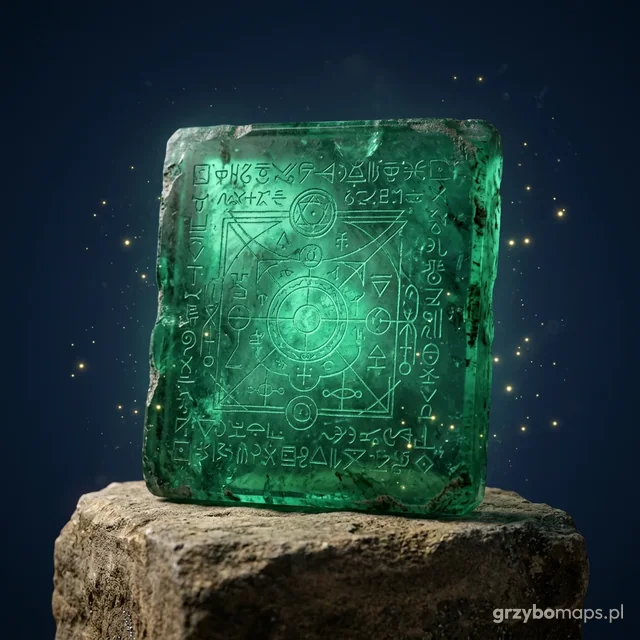
Emerald Tablet
alchemy (Hermeticism)
This is how it looks in your profile
This artefact is waiting somewhere in the forest. When you find it while mushroom picking, its animated icon will light up in your Trophies, in the Artefact Display Case. Legendary artefact gives 50 pts in the league.
A short, enigmatic text attributed to Hermes Trismegistus. According to legend it was engraved on an emerald slab found in Hermes’ tomb.
Origin
The oldest known versions of the text of the Tablet are Arabic: it was written down as the conclusion of the treatise “The Book of the Secret of Creation” (“Kitab sirr al-khaliqa”), attributed to Balinas, that is Apollonius of Tyana, usually dated to the 8th or 9th century. In the 12th century it was translated into Latin and from then on was one of the most commented-upon texts of alchemy.
History
In the framing story of the treatise Balinas descends into a crypt beneath the statue of Hermes in Tyana. In the darkness an old man sits there on a golden throne, holding in his hands a tablet of emerald with a text engraved on it. Beside him lies a book on the secrets of creation. Balinas reads the words and passes them on to posterity.
Other legends arose later. According to some, the Tablet was found in the tomb of Hermes Trismegistus himself, “thrice greatest”, who was identified with the Egyptian god Thoth. In other versions it was discovered by Sarah, Abraham’s wife, in a cave near Hebron, or by Alexander the Great. The emerald slab itself has never been shown.
The text has only a dozen or so sentences. It begins with the assurance that it is true without falsehood, and then says that what is below is like what is above, to accomplish the miracles of one thing. It describes a thing whose father is the Sun, whose mother is the Moon, which the wind carried in its womb and whose nurse is the earth. Alchemists believed it to be an encoded recipe for the philosopher’s stone.
In the Middle Ages the Tablet was commented on by, among others, Hortulanus (14th century), and in the 17th century Isaac Newton translated it and annotated it. His manuscript is kept at King’s College, Cambridge. For Hermeticists and later esoteric movements, the sentence “as above, so below” became a watchword of the unity of the universe.
How it works
Alchemists believed that the recipe for the philosopher’s stone was hidden in the dozen or so sentences of the tablet. The most famous principle says that what is below is like what is above. Only an initiate was supposed to be able to understand it.
Powers
- As above, so below: The Tablet teaches that the earthly world mirrors the heavenly one, so by knowing one, you come to know the other.
- The key to the Great Work: It was believed that whoever understood the text would be able to prepare the philosopher’s stone.
- Separating the subtle from the gross: The Tablet commands the separation of earth from fire, gently and with great wisdom, which alchemists read as a laboratory instruction.
- The power of the whole world: According to the text, whoever accomplishes the work will gain the glory of the whole world, and darkness will depart from him.
Fate
The physical emerald slab has never been found and is regarded as a legend. The text survives in dozens of manuscripts and translations, and Newton’s translation from the Keynes collection (Keynes MS 28) is available at King’s College, Cambridge.
In culture
The sentence “As above, so below” has become a popular motif of esotericism and appears in fantasy literature and computer games. The title of the American horror film “As Above, So Below” (2014) refers directly to the Tablet.
Fun fact
The oldest known versions of the text are in Arabic, and historians date them to between the 6th and 10th centuries. The tablet was translated into English by Isaac Newton himself.