

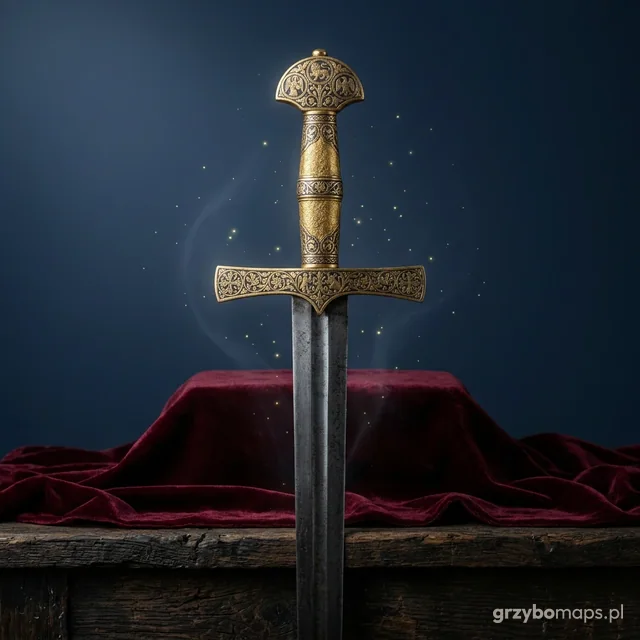
Szczerbiec
Polish history and legend
This is how it looks in your profile
This artefact is waiting somewhere in the forest. When you find it while mushroom picking, its animated icon will light up in your Trophies, in the Artefact Display Case. Legendary artefact gives 50 pts in the league.
The coronation sword of the kings of Poland, used from the coronation of Władysław the Elbow-high in 1320 until 1764. Legend links it with Bolesław the Brave, who was said to have nicked it against the Golden Gate of Kyiv.
Origin
The sword was forged in the 12th or 13th century, according to the latest analyses of style and inscriptions around the middle of the 13th century, and some researchers link it with Duke Bolesław of Mazovia. The oldest thread of the legend comes from Gallus Anonymus (early 12th century), who writes that Bolesław the Brave, riding into Kyiv in 1018, struck the Golden Gate with his sword. Only the 13th-century Greater Poland Chronicle added that the blade got its nicks from that blow.
History
The year 1018. Bolesław the Brave rides victoriously into Kyiv to place his son-in-law Sviatopolk on the throne. The chronicler Gallus Anonymus wrote that the prince, passing through the gate, struck it with a sweep of his sword, as if to show that the city now belonged to him. One of the most famous Polish legends grew from this scene.
Later storytellers added the rest: the blow against the Golden Gate left a nick in the blade, and the sword was named Szczerbiec (the Jagged Sword). The catch is that the Golden Gate in Kyiv was built only around 1037, and the surviving sword was made more than two centuries after Chrobry’s expedition. The legend, however, proved stronger than chronology.
Since the coronation of Władysław the Elbow-high in 1320, Szczerbiec was the coronation sword. The new king received it in Wawel Cathedral as a sign that he was to defend the Church, widows, orphans and the whole kingdom. On the hilt are the symbols of the four evangelists, the Lamb of God and mysterious inscriptions, partly written in letters resembling Hebrew, which researchers link with medieval protective formulas.
In 1795 the Prussians plundered the Crown Treasury at Wawel. Most of the regalia were melted down, but Szczerbiec survived: throughout the 19th century it passed from hand to hand among collectors, until in 1884 it was bought for the Hermitage in St Petersburg. It returned to Poland in 1928 under the provisions of the Treaty of Riga.
In September 1939 the sword, together with other treasures of Wawel, set out on a dramatic evacuation through Romania and France all the way to Canada. It returned to Wawel only after years of disputes, in 1959 (some sources give 1961).
How it works
According to tradition, the sword was a sign of royal justice: at the coronation the new ruler received it as defender of the country and the faith. The legend of the nick made in Kyiv does not hold up, however, because the Golden Gate was built only in 1037, and the sword itself dates from the 12th or 13th century.
Powers
- A sign of legitimate rule: According to coronation tradition, only a king girded with Szczerbiec was a true defender of the kingdom.
- The nick from Kyiv: Legend has it that the mark on the blade was left by Chrobry’s blow against the Golden Gate, which historians regard as a later tale.
- Protective words: In the medieval belief, the inscriptions and symbols on the hilt were meant to protect the owner and sanctify his rule.
- Survival: As the only coronation regalia it escaped the plunder of 1795, which for many became almost a legend in itself.
Fate
Szczerbiec is now displayed in the Crown Treasury at the Royal Castle on Wawel. It is the only surviving medieval coronation regalia of the Polish kings.
In culture
The image of Szczerbiec appeared on badges and symbols of national organizations in the 20th century, and the sword often appears in Polish historical literature and education as a symbol of the old Commonwealth.
Fun fact
The name comes from the word “szczerba”, a notch in the blade. It is the only surviving medieval coronation insignia of Poland; during the Second World War it was hidden in Canada and returned to Wawel only in 1959.