

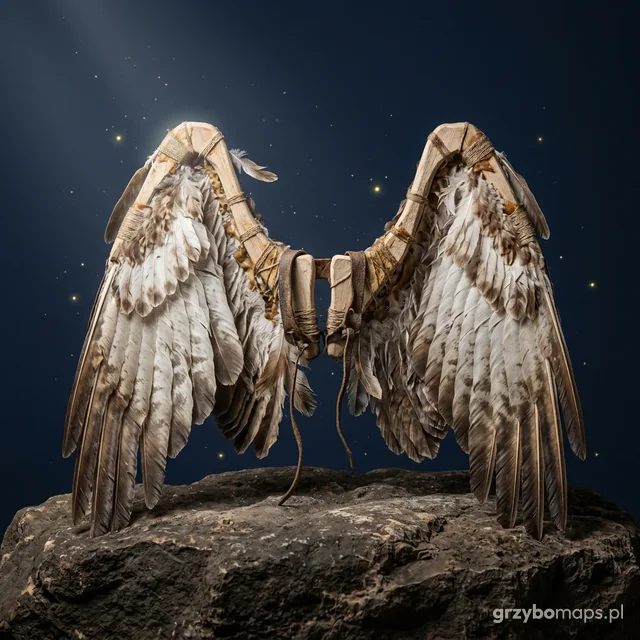
Wings of Icarus
mitologia grecka
This is how it looks in your profile
This artefact is waiting somewhere in the forest. When you find it while mushroom picking, its animated icon will light up in your Trophies, in the Artefact Display Case. Common artefact gives 5 pts in the league.
Wings of bird feathers that the inventor Daedalus made for himself and his son Icarus in order to escape from Crete, where King Minos held them prisoner.
Origin
The wings were built by Daedalus, an Athenian inventor, sculptor and architect, who was staying on Crete with King Minos. The fullest version of the story of the flight was left by Ovid in Book VIII of the “Metamorphoses” and in the “Ars Amatoria” (turn of the eras), and Apollodorus also wrote about Daedalus and the labyrinth.
History
Daedalus fled from Athens after throwing his talented pupil and nephew Talos, also called Perdix, from the Acropolis out of jealousy. On Crete he served Minos: he built a wooden cow for Queen Pasiphaë, and then a labyrinth for the Minotaur born of that union. When he helped Ariadne and Theseus, the angry king kept him on the island together with his son Icarus.
“Minos may rule the land and the sea, but the sky is open,” says Daedalus in Ovid. He arranged the feathers from the shortest to the longest, bound them with thread and wax, and curved them like real bird wings. Icarus played with the feathers and kneaded the wax, not knowing he was touching his own doom. His father taught him to fly and warned him: keep to the middle, between the sea and the sun.
Fishermen, shepherds and plowmen, seeing them over the sea, took them for gods. Icarus, intoxicated with flight, began to climb higher and higher, until the sun softened the wax and the feathers scattered. He flapped his bare arms, called for his father and fell into the sea, which was named the Icarian Sea after him. Daedalus found the feathers on the waves and buried his son on the island, henceforth called Icaria.
Daedalus flew to Sicily, to the court of King Cocalus. Minos searched for him all over the world with a riddle: who could thread a string through a spiral shell. Daedalus tied the thread to an ant, which passed through the shell, and Minos then knew where the inventor was hiding. He demanded that he be handed over, but Cocalus’s daughters killed Minos in his bath by pouring boiling water over him.
How it works
According to the myth, the feathers were bound together with thread and wax, and the wings let them fly like a bird. Daedalus warned his son not to fly too low, because the sea’s damp would weigh down the feathers, nor too high, because the sun would melt the wax. Icarus was delighted by flight, soared too high and fell into the sea, while Daedalus arrived safely.
Powers
- Flight like a bird: Wings of feathers and wax allow a human to soar into the air.
- Escape from captivity: They offer a road to freedom where land and sea are guarded.
- The limit of audacity: They work only at a moderate height: too low and the water weighs down the feathers, too high and the sun melts the wax.
- A lesson in moderation: In the myth the wings are a warning against pride and disregard for advice.
Fate
According to Virgil in the “Aeneid”, Daedalus landed at Cumae in Italy, built a temple of Apollo and deposited his wings in it as a gift to the god. In 1988 the Greek cyclist Kanellos Kanellopoulos flew the human-powered aircraft MIT Daedalus from Crete to Santorini, about 115 km.
In culture
The fall of Icarus is depicted in a painting attributed to Bruegel, about which W. H. Auden wrote in his poem “Musée des Beaux Arts”. The short story “Icarus” by Jarosław Iwaszkiewicz, about the arrest of a boy in occupied Warsaw whom no one notices, also alludes to this painting.
Fun fact
The island of Icaria and the Icarian Sea are named after Icarus. His fall is depicted in a famous painting attributed to Pieter Bruegel the Elder, held in the Royal Museums of Fine Arts of Belgium in Brussels.