

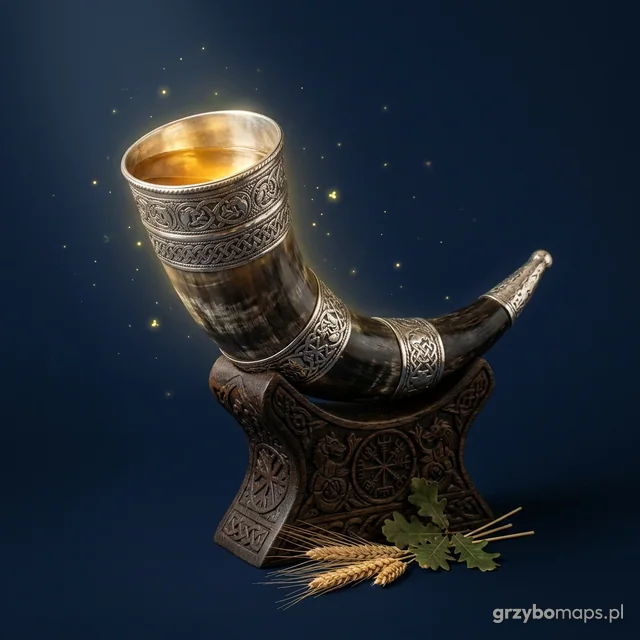
Horn of Świętowit
Slavic mythology
This is how it looks in your profile
This artefact is waiting somewhere in the forest. When you find it while mushroom picking, its animated icon will light up in your Trophies, in the Artefact Display Case. Rare artefact gives 15 pts in the league.
The four-headed statue of Świętowit in the temple at Arkona on Rügen held a horn that the priests filled with drink every year. From how much of the liquid was gone, they foretold the harvest for the following year.
Origin
The horn was held in its right hand by the statue of Świętowit (Svantevit), the four-headed god of the Polabian Slavs, in the temple on Cape Arkona on the island of Rügen. It was described most precisely by the Danish chronicler Saxo Grammaticus in Book XIV of the “Gesta Danorum”, written at the turn of the 12th and 13th centuries.
History
On the high cliff of Arkona, surrounded by sea on three sides, stood a wooden temple with purple curtains. Inside towered an enormous statue with four heads looking in the four directions of the world. In its right hand the god held a horn of various metals, in its left a bow, and beside it lay his saddle, bridle and a gigantic sword.
Once a year, after the harvest, the people of Rügen gathered before the temple. The priest, who the day before had carefully swept the sanctuary, holding his breath so as not to defile the god, took the horn from the statue's hand. If little mead was missing, he foretold a good harvest. If much, he advised saving grain. Then he poured the old drink out at the god's feet, filled the horn anew and drank it to the prosperity of the people.
Saxo also describes other wonders of Arkona. Świętowit had a white horse that only the priest might ride. It was believed that at night the god himself mounted it to fight his enemies, and in the morning the horse stood sweating and muddy. Before a military expedition it was led through rows of crossed spears, and from which foot it stepped over them first, victory or defeat was foretold. The temple was guarded by 300 horsemen.
At the end of the feast the priest stood behind an enormous honey cake, almost as tall as a man, and asked those gathered whether they could see him. When they answered that they could, he wished that next year they would not see him at all. This did not mean his disappearance, but a still greater harvest and a still greater cake.
It all ended in 1168 (some sources give 1169). The Danish king Valdemar I and Bishop Absalon captured Arkona. The statue was hacked at the feet, toppled, dragged out of the temple and chopped up for firewood. Saxo recorded that at the moment of its fall a demon in the form of a black animal ran out from inside.
How it works
According to the chronicle of Saxo Grammaticus, the horn in the statue’s right hand was filled every year with mead. After a year the priest checked how much of the drink was gone: a full horn foretold a bumper harvest and a loss foretold a poor one, in which case he advised saving supplies. Then he poured the old mead out at the feet of the statue and filled the horn anew.
Powers
- Harvest omen: According to Saxo, the level of mead in the horn after a year foretold whether the next harvest would be abundant.
- Voice of the god: The priest read Świętowit's will from the horn and advised the people on how to manage their supplies.
- Toast to prosperity: Drinking the freshly filled horn was meant to ensure the people wealth and victories.
- Vigilance in four directions: The four faces of the statue that held the horn saw the whole world at once.
Fate
The horn from Arkona was destroyed together with the statue and the temple, and to this day only traces of the stronghold survive, partly sliding into the sea. What did survive is the stone Zbruch Idol, a four-sided statue with a horn in the hand of one of the figures, fished out in 1848 and kept in Kraków since 1851.
In culture
The Zbruch Svetovid is one of the best-known Slavic monuments in Poland, and its image and copies appear in textbooks, on posters and in the names of many Polish cultural institutions.
Fun fact
A horn is also held by the stone Światowid of Zbruch, a statue fished in 1848 out of the Zbruch river. Today it can be seen in the Archaeological Museum in Kraków.