

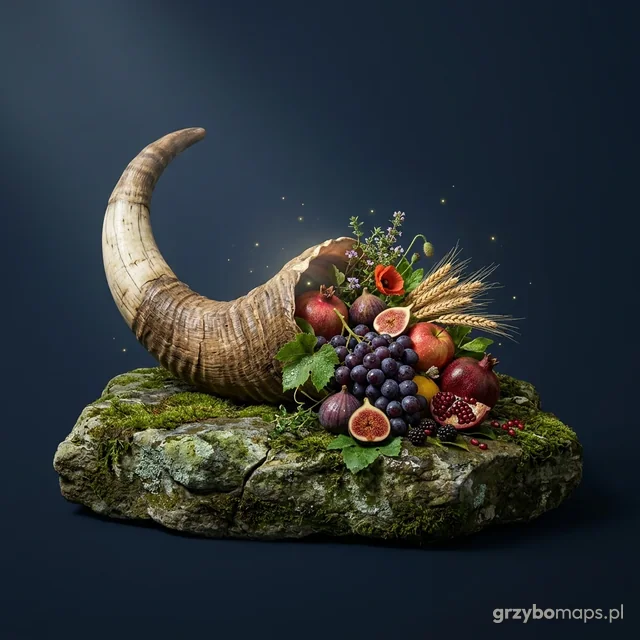
Cornucopia
mitologia grecka
This is how it looks in your profile
This artefact is waiting somewhere in the forest. When you find it while mushroom picking, its animated icon will light up in your Trophies, in the Artefact Display Case. Rare artefact gives 15 pts in the league.
The horn of the goat Amalthea, who in a cave on Crete nursed with her milk the infant Zeus, hidden from his father Cronus. The horn broke off, and Zeus endowed it with a wondrous power.
Origin
The cornucopia, in Latin cornu copiae, comes from the myths about Zeus's childhood on Crete. The story of Amalthea is passed down by, among others, Ovid in the “Fasti” and Apollodorus, and the story of Heracles and the river god Achelous was already described by Sophocles in the “Women of Trachis” (5th century BC) and by Ovid in the “Metamorphoses”.
History
Cronus swallowed his children for fear of a prophecy that one of them would take his power. Rhea gave him a stone wrapped in swaddling clothes, and hid the little Zeus in a Cretan cave. He was nursed by the goat Amalthea, or in another version by the nymph Amalthea, who owned a goat. The Curetes, young warriors, danced before the cave beating their shields so that Cronus would not hear the child's crying.
Ovid relates that the goat broke off a horn on a tree, and the nymph wrapped it in fresh herbs, filled it with fruit and offered it to Zeus. When Zeus took power over the world, in gratitude he placed the goat in the sky and endowed her horn with a power: it would fill itself with whatever its owner desired. In the constellation Auriga the star Capella, “the Little Goat”, still shines today, identified with Amalthea.
The second story belongs to Heracles. The hero fought the river god Achelous for the hand of Deianira. Achelous changed into a serpent, then into a bull, but Heracles seized him by the horns and broke one off. According to Ovid, the naiads filled this horn with fruit and flowers, and according to Apollodorus, Achelous ransomed his horn by giving Heracles the horn of Amalthea.
The horn then passed into the hands of the deities of fortune and plenty. It was carried by Plutus, the god of wealth, Tyche, the goddess of fate, and among the Romans Fortuna and Abundantia. As a result, in Greek and Roman art the overflowing horn was the simplest sign of prosperity and good harvests.
How it works
According to the myths, the horn fills itself with whatever its owner desires: fruit, grain, even nectar and ambrosia. It never runs empty, however endlessly one draws from it. In another version it was the horn of the river god Achelous, broken off by Heracles and filled with fruit by the nymphs.
Powers
- Inexhaustible plenty: The horn never empties, however much is drawn from it.
- Fulfilling wishes: It fills with exactly what its owner desires.
- Food of the gods: In some accounts it even gives nectar and ambrosia.
- Sign of good fortune: It is an attribute of the deities of fate, wealth and fertility.
Fate
The myth does not say where the horn finally ended up, except that it passed to the deities of plenty. As a symbol it has remained alive: it appears on the coats of arms of Peru, Colombia and Venezuela, on coins and on bank buildings.
In culture
In the United States a basket in the shape of a cornucopia is a typical Thanksgiving decoration. The cornucopia is often held by allegories of Peace and Plenty in Baroque paintings and sculptures, including in Polish palaces and churches.
Fun fact
The Latin name cornu copiae gave the English word cornucopia. The horn of plenty appears in the coats of arms of states, for example Peru, where gold coins spill out of it.