

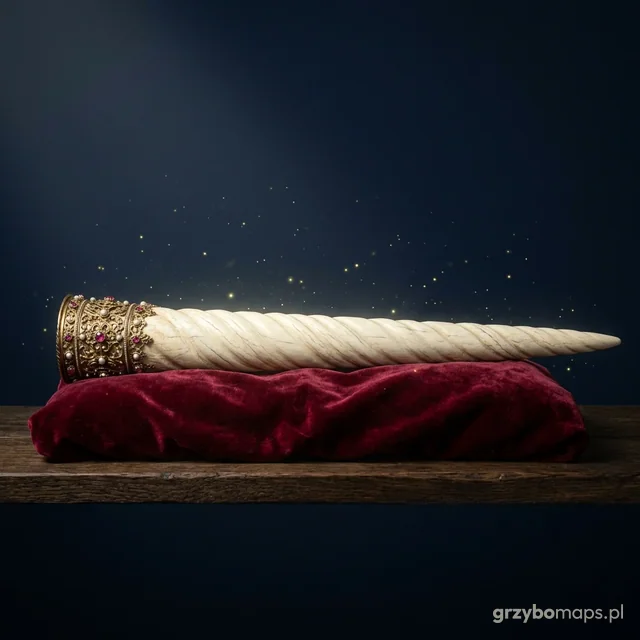
Unicorn horn
Middle Ages
This is how it looks in your profile
This artefact is waiting somewhere in the forest. When you find it while mushroom picking, its animated icon will light up in your Trophies, in the Artefact Display Case. Legendary artefact gives 50 pts in the league.
In the Middle Ages and the Renaissance, the “unicorn horn” was one of the costliest treasures of royal vaults. In reality these were narwhal tusks, brought from the distant North.
Origin
The oldest description of the unicorn was given by the Greek physician Ctesias of Cnidus around 400 BC. He wrote of wild asses from India with a single horn on the forehead, from which cups protect against poison. In the Middle Ages the legend merged with narwhal tusks, which merchants brought from Greenland and Scandinavia and sold as unicorn horns.
History
According to the medieval “Physiologus” and bestiaries, the unicorn is wild and so strong that no hunter can capture it. This succeeds only with the help of a virgin: the animal comes to her by itself, lays its head in her lap and falls asleep. Only then can the hunters seize it. In Christian tradition the story was read as an allegory of the Incarnation of Christ.
Another legend says that when a serpent poisoned the water at a spring, the animals waited until the unicorn came and dipped its horn in it, purifying the water. That is why the horn was regarded as the best defence against poisoning, which was a real scourge of courts. Goblets, spoons and handles made of “horn” adorned the tables of rulers, and powdered horn was the most expensive medicine in apothecaries.
Horns reached prices higher than gold. In 1564 the brothers of the House of Habsburg declared their “unicorn horn”, together with the famous agate bowl, the indivisible property of the dynasty, which no member of the house could sell. A narwhal tusk over two metres long still lies today in the treasury at the Hofburg in Vienna.
The truth was revealed in 1638 by the Danish naturalist Ole Worm, who showed publicly that the “horns” are narwhal teeth. Even so they were used for a long time, and in the 17th century the Danish coronation throne was built from them. Belief in the horn as an antidote faded only in the 18th century, when physicians stopped prescribing it.
How it works
It was believed that the horn neutralised any poison. Goblets were made from horns, and powdered horn was sold as medicine. It was supposedly able to sweat or change colour near poisoned food.
Powers
- Antidote: The horn was supposed to neutralise any poison in a drink into which it was dipped.
- Poison detection: According to belief, it sweated, changed colour or caused fizzing near poisoned food.
- Purifying water: In the legend the unicorn purifies a poisoned spring by touching it with its horn.
- Healing: Powdered horn was given as a remedy for fevers, epilepsy and wounds, which science has not confirmed.
Fate
The narwhal tusk from Vienna is in the Imperial Treasury at the Hofburg, and the throne made of narwhal tusks stands in Rosenborg Castle in Copenhagen. Real unicorns never existed, and narwhals live today in the waters of the Arctic.
In culture
The famous tapestries “The Hunt of the Unicorn” are in The Cloisters in New York, and the cycle “The Lady and the Unicorn” in the Musée de Cluny in Paris. In Polish heraldry the unicorn appears in the Bończa coat of arms.
Fun fact
The coronation throne of the Danish kings from the 17th century, kept at Rosenborg Castle in Copenhagen, was made of narwhal tusks passed off as unicorn horns. As early as 1638 the Danish physician Ole Worm showed where they really came from.