

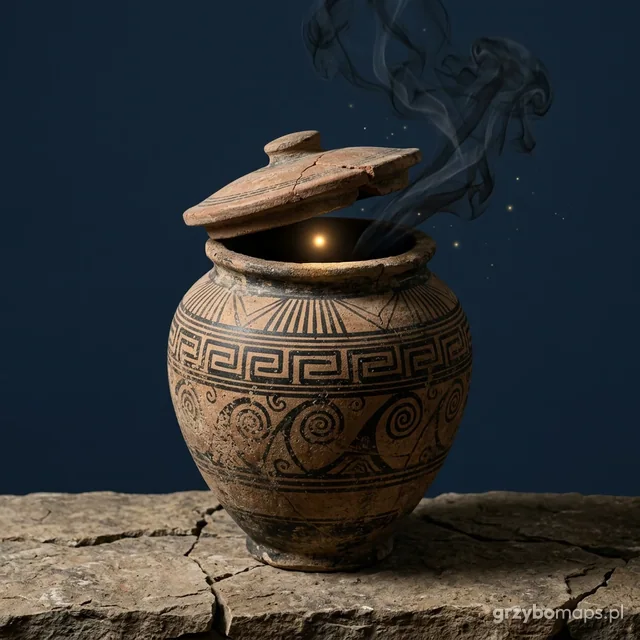
Pandora’s box
mitologia grecka
This is how it looks in your profile
This artefact is waiting somewhere in the forest. When you find it while mushroom picking, its animated icon will light up in your Trophies, in the Artefact Display Case. Rare artefact gives 15 pts in the league.
Pandora, the first woman, created by the will of Zeus, received from the gods a vessel that she was forbidden to open. When she lifted the lid a little, all the misfortunes flew out into the world, and only hope remained inside.
Origin
The story of Pandora and her vessel comes from Hesiod, a Boeotian poet of the turn of the 8th and 7th centuries BC, who described it in the “Theogony” and in “Works and Days”. Hephaestus moulded the woman from earth and water at Zeus's command, and each of the gods endowed her with something, hence her name meaning “all-gifted”.
History
The Titan Prometheus outwitted Zeus twice: first he cheated him in the division of a sacrificial ox, then he stole fire from the gods and carried it to people in the stalk of a fennel. Zeus resolved to repay people with a gift that would look like a reward but prove to be a punishment. That gift was Pandora.
Athena taught her to weave and dressed her in a silver garment, Aphrodite gave her grace, and Hermes, as Hesiod writes, “a dog's mind”, lying words and cunning. Hermes led Pandora to Epimetheus, the brother of Prometheus. Prometheus had warned him not to accept any gifts from Zeus, but Epimetheus, whose name means “afterthought”, received her gladly.
Before this, people lived without toil, without heavy labour and without disease. Pandora took the great lid off a clay jar, and thousands of misfortunes scattered over the world. Diseases, Hesiod writes, now roam among people on their own, by day and by night, silently, because Zeus took away their voice. Only Hope, in Greek Elpis, remained under the rim of the vessel, because Pandora slammed the lid shut before it could fly out.
Hesiod does not explain where the vessel came from or why Pandora opened it, and it is precisely this gap that has provoked dispute for centuries. Is the hope shut in the jar a consolation left to people, or one more evil that deceives them? In a later, gentler version, known from the fables of Babrius among others, the vessel held goods that escaped to the gods, and only hope was left with humans.
How it works
According to Hesiod, Zeus wanted to punish humans in this way for the fire stolen by Prometheus. The vessel held sealed diseases, toil and suffering, which humans had not known before. All it takes is lifting the lid a little, and the evil escapes on its own and can no longer be caught. Pandora managed to slam it shut only enough for hope to remain inside.
Powers
- Release of misfortunes: Merely lifting the lid is enough for disease, toil and suffering to scatter across the world.
- Cannot be undone: Evil once released cannot be caught and put back in the vessel.
- Silent diseases: According to Hesiod, the diseases from the vessel are invisible and silent, and come without warning.
- Imprisoned hope: The only thing that did not leave the vessel is hope.
Fate
The box does not exist and was never an object of search, but its name travelled through translations. Erasmus of Rotterdam in his “Adagia” changed pithos, a large storage jar, into pyxis, a small casket, and so “Pandora's box” came about. Today it is a proverbial expression for an action whose consequences can no longer be stopped.
In culture
The German silent film “Pandora's Box” (1929), directed by Georg Wilhelm Pabst, with Louise Brooks, is a classic of cinema. The art historian Erwin Panofsky, together with his wife Dora, described the history of this motif in the book “Pandora's Box” (1956).
Fun fact
In Hesiod’s poem “Works and Days” it was a large clay jar, a pithos. We owe the “box” (Latin pyxis) to Erasmus of Rotterdam, who in the 16th century confused the two words in his translation.