

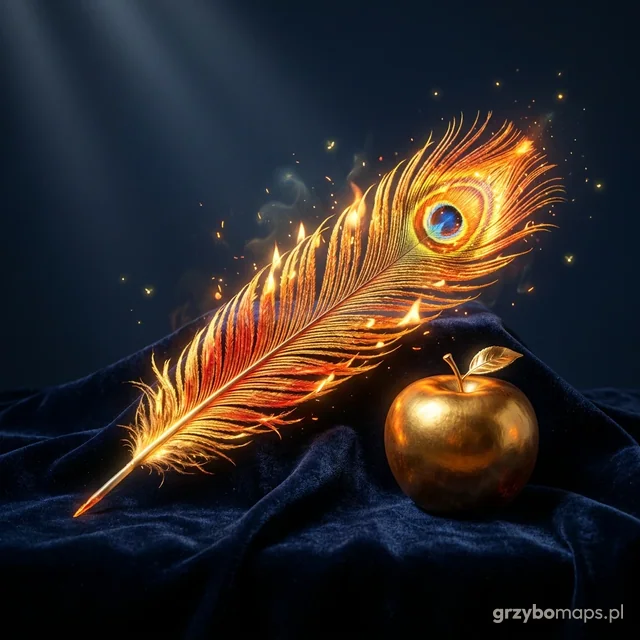
Feather of the Firebird
East Slavic fairy tales
This is how it looks in your profile
This artefact is waiting somewhere in the forest. When you find it while mushroom picking, its animated icon will light up in your Trophies, in the Artefact Display Case. Rare artefact gives 15 pts in the league.
The Firebird is a wondrous bird from Russian fairy tales, resembling a peacock, whose feathers burn with living fire. A single one of its feathers was enough to set out on the farthest journey.
Origin
The Firebird (Russian: Zhar-ptitsa) is a wondrous bird from Rus' fairy tales whose feathers shine like flame. The most famous stories about it were written down in the 19th century by Alexander Afanasyev, and its feather also plays a key role in Pyotr Yershov's poem “The Little Humpbacked Horse” (1834).
History
Tsar Vyslav Andronovich had a garden, and in it an apple tree with golden apples. Every night someone stole them. The tsar sent his three sons to keep watch: Dmitri and Vasili fell asleep, but the youngest, Ivan, stayed awake. At midnight the garden lit up as if by day, and the Firebird flew down onto the apple tree. Ivan threw himself at it, but managed to pull out only one feather.
The feather was so bright that in a dark chamber it shone like a thousand candles. The tsar longed for the bird itself and sent his sons out into the world. At a crossroads Ivan lost his horse, which a grey wolf devoured, but that same wolf became his faithful helper and carried him to the garden of Tsar Dolmat, where the Firebird sat in a golden cage.
The wolf warned: take the bird, but do not touch the cage. Ivan did not listen, bells rang and the guards seized him. Dolmat spared his life on condition that he bring the horse with the golden mane from Tsar Afron. There Ivan broke the prohibition again, so in exchange he had to win Elena the Beautiful. Only through the cunning of the wolf, who turned himself into a horse and into a princess, did Ivan obtain everything at once.
In Yershov's “The Little Humpbacked Horse”, Ivanushka finds a glowing feather in a field, although his magical little horse warns that it will bring him a lot of trouble. The feather reaches the tsar, and Ivanushka then has to catch the Firebird itself and perform further dangerous tasks. Likewise, in Afanasyev's tale of the Firebird and Princess Vasilisa, the archer picks up the feather against the advice of his horse.
How it works
The feather glows even after it has been plucked, so brightly that in a dark chamber it gives as much light as a multitude of candles. In the tale of Tsarevich Ivan and the grey wolf, the bird stole golden apples from the tsar every night, and the prince managed to pluck only one feather from it. That was enough for the tsar to send his sons after the bird itself.
Powers
- Light without flame: The feather shines so brightly that it lights a dark chamber like a multitude of candles, and yet it does not burn.
- Sign of destiny: Whoever picks it up is drawn into a great quest and can no longer back out.
- Lure for the bird: The feather awakens in rulers a desire for the Firebird itself and becomes the beginning of all the tasks.
- Warning for the disobedient: In fairy tales trouble falls on whoever disregards the advice of the magical helper.
Fate
According to the tale, the Firebird in a golden cage ended up at the court of Tsar Vyslav, but the feather remained only in stories. Today it is one of the most common motifs of Russian folk art, of Palekh lacquer painting and of Ivan Bilibin's illustrations.
In culture
Igor Stravinsky's ballet “The Firebird” (1910) and Yershov's fairy tale “The Little Humpbacked Horse” are the most famous works in which it appears. The tale of Tsarevich Ivan, the Firebird and the grey wolf was illustrated by Ivan Bilibin, among others, and Viktor Vasnetsov painted “Tsarevich Ivan on the Grey Wolf” (1889).
Fun fact
The tale inspired Igor Stravinsky's ballet “The Firebird”, first staged in Paris in 1910 by Sergei Diaghilev's Ballets Russes.