

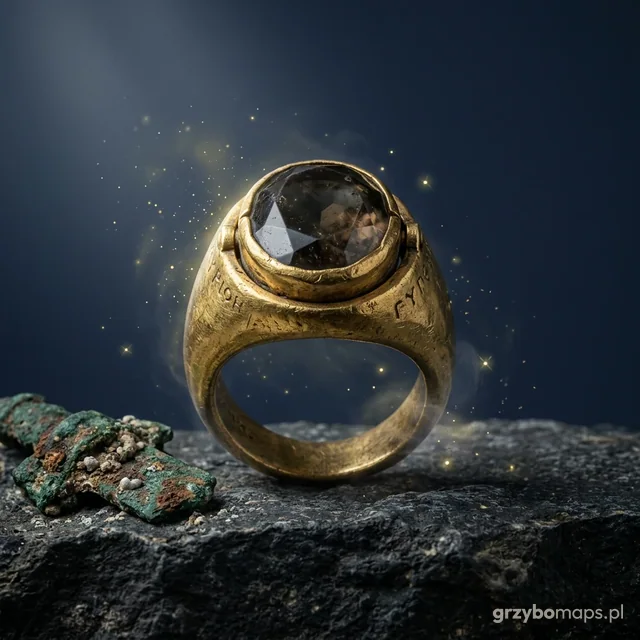
Ring of Gyges
Greek philosophy (Plato)
This is how it looks in your profile
This artefact is waiting somewhere in the forest. When you find it while mushroom picking, its animated icon will light up in your Trophies, in the Artefact Display Case. Rare artefact gives 15 pts in the league.
A golden ring from a story that Plato put in the mouth of Glaucon in the dialogue “Republic”. The shepherd Gyges found it after an earthquake in an underground cave, on the finger of a giant corpse hidden in a bronze horse.
Origin
The ring does not come from mythology but from philosophy. Glaucon tells of it in Book II of Plato's “Republic”, written around 375 BC, as a thought experiment. In Plato's text the hero is a shepherd called “an ancestor of Gyges the Lydian”, although tradition simply speaks of Gyges.
History
The shepherd served the king of Lydia in Asia Minor. One day, after a great downpour and an earthquake, a chasm opened in the place where he grazed his flocks. He went down into it and saw wonders, among them a hollow bronze horse with small doors. Inside lay a corpse, larger than an ordinary man, naked, with only a single gold ring on its finger. The shepherd took off the ring and came out.
At the monthly meeting of the shepherds, who reported to the king on the flocks, he was playing with the ring. When he turned the bezel toward the inside of his palm, he noticed that the others were talking about him as about someone absent. When he turned the bezel outward, they saw him again. He tested it several times and it always worked.
The shepherd saw to it that he was sent as a messenger to the king. At court he seduced the queen, killed the king together with her and himself took the throne of Lydia. Glaucon argues that everyone, just or unjust, would behave the same way if he had two such rings and could do anything without witnesses. People are honest, he claims, only out of fear of punishment.
For the rest of the “Republic”, Socrates tries to refute this thesis. In Book X he concludes that justice is good in itself and should be chosen even if someone had the ring of Gyges and, on top of that, the helmet of Hades. The unjust man, even one who goes unpunished, is according to Socrates a slave of his own desires.
How it works
According to the story, all it takes is to turn the bezel of the ring towards the inside of the palm, and the owner becomes invisible. Turning it the other way restores visibility. Gyges used this to seduce the queen, kill the king of Lydia and seize the throne. Plato thus asks whether anyone would remain honest if nobody could see him.
Powers
- Invisibility: Turning the bezel toward the inside of the palm makes the wearer invisible.
- Full control: Turning it the other way immediately restores visibility.
- Test of character: The ring shows what a person is really like when no one sees him.
- Road to the throne: In the story it gave an ordinary shepherd power over a kingdom.
Fate
The ring is a literary invention, but Gyges was a real king of Lydia in the 7th century BC, mentioned in the Assyrian chronicles of King Ashurbanipal as Gugu. Herodotus relates that Gyges killed King Candaules and married his wife for an entirely different reason: the king had ordered him to secretly watch the naked queen.
In culture
Cicero considered the ring of Gyges in his treatise “On Duties”, and Friedrich Hebbel wrote the drama “Gyges and His Ring” (1856). It is often compared with the One Ring from Tolkien's “The Lord of the Rings”, although there is no proof that Tolkien modelled it on it.
Fun fact
Gyges was a real king of Lydia, who reigned in the 7th century BC. Herodotus described his rise to power quite differently, without any magic ring.