

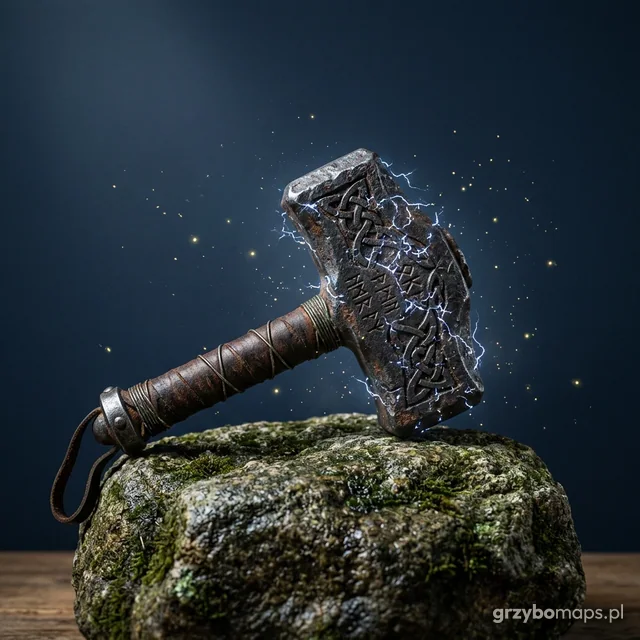
Mjölnir
mitologia nordycka
This is how it looks in your profile
This artefact is waiting somewhere in the forest. When you find it while mushroom picking, its animated icon will light up in your Trophies, in the Artefact Display Case. Legendary artefact gives 50 pts in the league.
The hammer of the storm god Thor, forged by the dwarves Brokkr and Eitri. When the giant Thrym stole the hammer, Thor dressed up as Freya and recovered it during a sham wedding.
Origin
Mjölnir was forged by the dwarf Eitri, while his brother Brokkr worked the bellows, in a forge underground. Snorri Sturluson tells the story of its making in the “Prose Edda” (c. 1220), and the older “Poetic Edda” poem, the “Lay of Thrym” (Þrymskviða), describes how the hammer was recovered from a giant.
History
It all began with a prank by Loki, who cut off the golden hair of Sif, Thor's wife. To escape the god's wrath, Loki ordered new hair made of gold from the sons of the dwarf Ivaldi, along with the ship Skidbladnir and the spear Gungnir. Then he bet his own head with the dwarf Brokkr that his brother Eitri could not make three equally wonderful things.
Eitri put a pig's skin, gold and iron into the fire, and Brokkr was to blow the bellows without stopping. Loki turned into a fly and bit him in turn on the hand, the neck and finally the eyelid, until blood ran into his eyes. Brokkr let go of the bellows for a moment to wipe it away, and that is why the hammer's handle came out too short. The gods still judged Mjölnir the best gift, because it would protect them from the giants. Loki lost the bet but talked his way out with cunning: the head belongs to Brokkr, but he had not promised the neck. So the dwarf sewed his mouth shut.
One morning Thor woke up without his hammer. The giant Thrym had hidden it eight leagues underground and demanded in exchange the hand of the goddess Freyja. Freyja refused so violently that her necklace burst, so Heimdall thought up a trick: Thor would go to the wedding in the bride's veil, and Loki as her bridesmaid. At the feast the “bride” ate a whole ox and eight salmon, and Loki explained that Freyja had longed for the wedding so much that she had eaten nothing for eight nights.
According to custom, Thrym ordered the hammer to be brought, to lay it in the bride's lap and bless the marriage. Thor, feeling the handle in his hand, tore off the veil and with a single swing dealt with Thrym and his whole kin. Thus ended the only wedding in history at which the bride had a red beard.
According to Snorri, the hammer did not only kill. Thor once slaughtered his two goats for supper and in the morning resurrected them by hallowing their bones with Mjölnir. With the same hammer he consecrated the funeral pyre of his brother Baldr. According to the “Vafþrúðnismál”, after Ragnarök the hammer will be inherited by Thor's sons, Modi and Magni.
How it works
According to Snorri's Edda, Mjölnir hits whatever Thor throws it at and always returns to his hand. It can also be shrunk so that it fits inside his tunic. It has only one flaw: the handle is too short, because Loki, in the form of a fly, bit the eyelid of Brokkr, who was working the bellows.
Powers
- Always hits: Thrown by Thor, it hit every target and never missed.
- Returns to the hand: After every throw it returned to its owner's hand by itself.
- Changes size: It could be shrunk so that it fit under a tunic.
- Power of hallowing: The hammer was used to hallow weddings, funeral pyres and the bones from which Thor's goats were reborn.
- Shield of Asgard: The gods prized it above all, because it defended them from the giants.
Fate
In the myths the hammer survives the end of the world and passes to Thor's sons, although Thor himself dies from the venom of the Midgard Serpent. In the real world, hundreds of hammer-shaped pendants from the Viking Age have survived, and Thor's hammer is today a symbol of modern followers of faith in the old Norse gods.
In culture
Mjölnir has been Thor's weapon in Marvel comics since 1962 and in the films about this hero, as well as in the “God of War” game series.
Fun fact
Throughout Scandinavia, archaeologists find small pendants in the shape of Thor's hammer, worn in the Viking Age as amulets.