

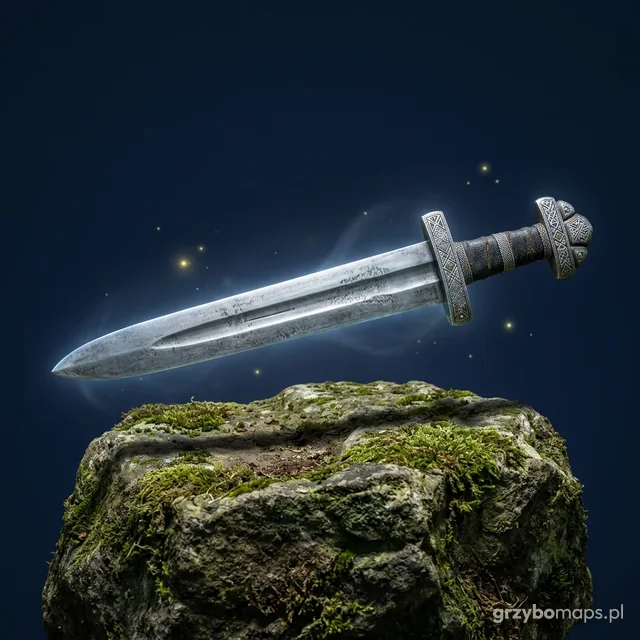
The Self-Slashing Sword
East Slavic fairy tales
This is how it looks in your profile
This artefact is waiting somewhere in the forest. When you find it while mushroom picking, its animated icon will light up in your Trophies, in the Artefact Display Case. Rare artefact gives 15 pts in the league.
Samosek is a magic sword from Russian fairy tales that fights on its own, without a knight's hand. It is sometimes identified with the famous kladenets sword, the hidden treasure of the heroes of the bylinas.
Origin
The samosiek sword, meaning “self-cutting”, is a magical weapon from Rus' fairy tales, belonging to the same family as the flying carpet, the self-setting tablecloth and the seven-league boots. It is often identified with the kladenets sword from byliny and folk tales, although some scholars distinguish the two swords.
History
In Rus' fairy tales the mightiest weapon never lies in plain sight. It is hidden under a heavy stone, in the wall of an old tower, underground or beneath the roots of a sacred tree, and waits for years until a true hero appears. An ordinary man cannot even move the boulder that covers it.
The samosiek does not need a knight's hand. It is enough to draw it and give the command, and it flies out by itself to meet the enemies, cuts down whole armies and many-headed dragons, then returns to its scabbard. The kladenets, by contrast, is sometimes described as an ordinary, though invincible, weapon that the hero must wield with his own hand. In many tales the two motifs blend.
The most famous story of a hidden sword was told by Pushkin in “Ruslan and Lyudmila” (1820). The knight Ruslan, searching for his abducted wife, meets the living head of a giant on a battlefield. After a fight he pushes it aside and finds a sword beneath it. The head confesses that its treacherous brother is the dwarf Chernomor, who cut it off, and that only this sword can cut the magic beard in which Chernomor's power lies.
Scholars have searched for the roots of the name kladenets. Some derive it from the Rus' word “klad”, treasure, others from the old “ukladnyj”, meaning steel, and still others from Clarence, the sword of the hero of an Italian chivalric romance about Bovo, which in the 16th and 17th centuries became the popular Rus' tale of Bova Korolevich.
How it works
It is enough to draw the sword and order it to fight, and it cuts down enemies and dragons by itself. It usually lies hidden under a stone, in a wall or under a sacred tree, waiting for a worthy hero. Some scholars, however, distinguish it from the kladenets, which had to be wielded by the bogatyr himself.
Powers
- Fights by itself: According to the tales, it is enough to draw it and give the command, and it cuts down enemies by itself.
- Dragon slayer: It is the only weapon able to defeat a many-headed dragon or an evil sorcerer.
- Waits for the worthy: It lies hidden under a stone or a tree and cannot be obtained without the hero's strength and courage.
- Indestructible: In byliny and fairy tales, no armour or spell can stop its blade.
Fate
The sword exists only in fairy tales and byliny, and after each expedition it usually vanishes from the story. Its legend survived in the Russian language, in which “kladenets sword” became a proverbial name for an invincible weapon.
In culture
The scene with the sword under the giant's head from “Ruslan and Lyudmila” found its way into Mikhail Glinka's opera (1842). The motif of a miraculous sword hidden for a hero has many European counterparts, foremost the sword in the stone from the Arthurian legends.
Fun fact
The name kladenets is derived from the Russian word “klad”, meaning treasure, or from Clarence, the sword from the Italian chivalric romance about Bovo, which found its way into Russian tales.