

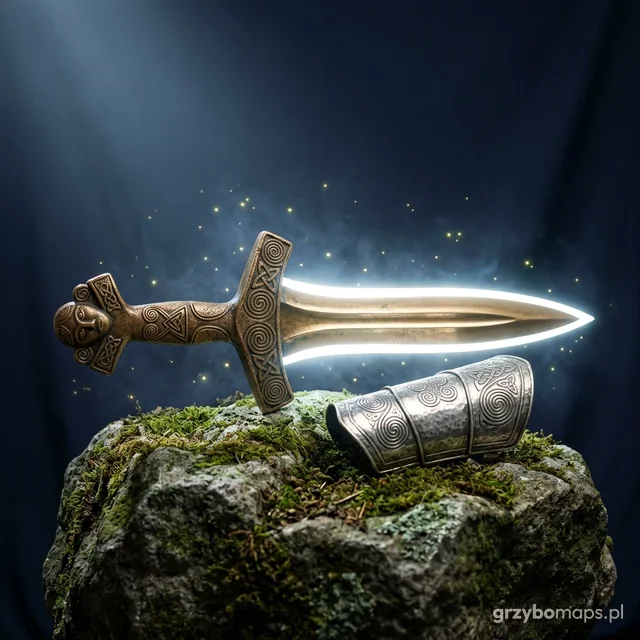
Sword of Nuada
Celtic (Irish) mythology
This is how it looks in your profile
This artefact is waiting somewhere in the forest. When you find it while mushroom picking, its animated icon will light up in your Trophies, in the Artefact Display Case. Rare artefact gives 15 pts in the league.
Nuada of the Silver Hand was the king of the gods of the Tuatha Dé Danann. His sword from the city of Findias was one of the four treasures of the gods, and later tradition links it with Claíomh Solais, the Sword of Light.
Origin
The sword belonged to Nuada Silver-Hand, the first king of the gods, the Tuatha Dé Danann, in Ireland. The gods brought it from Findias, where the sage Uiscias taught them, as described in medieval texts about the four treasures and in the “Book of Invasions of Ireland” (11th century). Later Irish and Scottish tales know a similar Claíomh Solais, the Sword of Light.
History
When the gods arrived in Ireland, the land belonged to the Fir Bolg people. In the first battle of Mag Tuired, Nuada fought the Fir Bolg warrior Sreng, who cut off his hand. The gods won, but the king lost his throne, because by law a ruler had to have a body without blemish.
Bres became king, half god and half Fomorian, handsome but miserly. His guests left the table with dry mouths, and the poet Coirpre composed the first satire in Ireland about him, which broke his power. Meanwhile Dian Cécht, the physician of the gods, made Nuada a working hand of silver, and his son Miach went further and restored the king's real hand of flesh and bone.
The jealous Dian Cécht killed his own son. From Miach's grave grew three hundred and sixty-five herbs, one for each joint and sinew of the human body, and his sister Airmed began to arrange them. But their father scattered her collection, and ever since, as the legend says, no one knows all the healing plants.
Nuada regained the throne, but when the Fomorians marched to war, he handed leadership to the young Lugh, master of all arts. In the second battle of Mag Tuired, Nuada fell at the hand of Balor of the deadly eye, and Lugh avenged him by killing Balor. The sword from Findias, from which no one could hide, did not save its master from fate.
How it works
According to the medieval text about the four treasures, no one could escape this sword once it was drawn from its scabbard, and no one was able to resist it. In later Irish and Scottish tales the gleaming Sword of Light is the goal of the hero's quest.
Powers
- No one escapes: Once the sword was drawn from its scabbard, no enemy could escape it.
- Irresistible: According to the text about the four treasures, no one could withstand its blows.
- Sword of Light: In later tales, Claíomh Solais shines like a torch and grants the hero victory.
- Gift from Findias: It was one of the four treasures of the gods, a sign of their rule over Ireland.
Fate
The texts do not say what happened to the sword after Nuada's death. Tradition has the gods take their treasures into the underground sídhe mounds. Nuada himself has close relatives: the Welsh Lludd Silver-Hand and the Romano-British god Nodens, whose temple was discovered at Lydney in England.
In culture
The motif of the Sword of Light from Irish tales returns in modern fantasy, and Nuada's silver hand is one of the most frequently invoked images of Irish mythology.
Fun fact
Nuada lost his hand in the first Battle of Mag Tuired, and with it his throne, because a king had to be without blemish. The divine physician Dian Cécht made him a hand of silver, and his son Miach later restored his real one.