

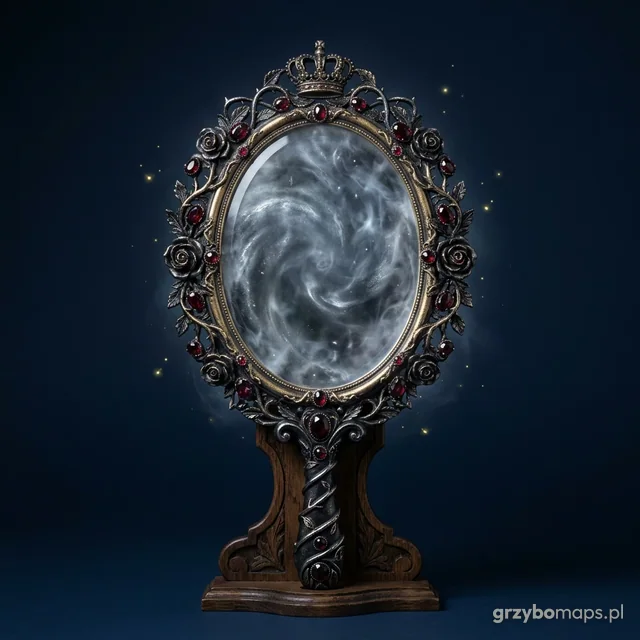
The Queen’s mirror
fairy tale (Brothers Grimm)
This is how it looks in your profile
This artefact is waiting somewhere in the forest. When you find it while mushroom picking, its animated icon will light up in your Trophies, in the Artefact Display Case. Legendary artefact gives 50 pts in the league.
The magic mirror of the wicked queen from the Brothers Grimm fairy tale “Snow White” (1812). Every day the queen asks it who is the fairest of all, and she flies into a rage when she hears Snow White’s name.
Origin
The mirror belongs to the evil queen from the tale “Snow White” (no. 53 in the Grimms’ collection), which the brothers Jacob and Wilhelm Grimm published in Germany in 1812 in the collection “Children’s and Household Tales”. In the original, the queen addresses it with the words “Spieglein, Spieglein an der Wand”, that is “mirror, mirror on the wall”.
History
One winter the queen sews at a window with an ebony frame, pricks her finger, and three drops of blood fall on the snow. She dreams of a daughter as white as snow, as red as blood and as black-haired as ebony. Snow White is born, and the queen dies. In the first edition of 1812 it is the birth mother who is jealous of her daughter; in later ones the Brothers Grimm turned her into a stepmother.
The new queen is beautiful and proud, and her magic mirror answers every question with the truth. For years she hears that she is the most beautiful in the land. When Snow White turns seven, the mirror replies that the princess is a thousand times more beautiful. The queen turns yellow and green with jealousy and orders a huntsman to kill the girl in the forest and bring back her lungs and liver. The huntsman takes pity and brings the innards of a young boar.
The mirror, however, cannot lie, and reveals that Snow White is alive beyond the seven mountains with the seven dwarfs. Three times the queen comes disguised as a pedlar woman: first she laces the princess tightly with a corset lace, then she combs her with a poisoned comb, and finally she offers her an apple whose red half is poisoned. The dwarfs lay Snow White in a glass coffin.
The prince carries the coffin to his castle, the servants stumble over a bush, and the bite of apple falls out of the princess's throat. The queen is invited to the wedding. The mirror tells her that the young queen is more beautiful, and at the wedding she must dance in red-hot iron shoes until she falls dead. The mirror, which throughout the whole tale spoke only the truth, thus became the instrument of her ruin.
How it works
The mirror always tells the truth and answers every question its owner asks. It is the one who tells the queen that Snow White is alive, hidden with the dwarfs beyond the seven mountains. In Polish translations the question usually runs: “Lustereczko, powiedz przecie…” (“Mirror, mirror, do tell me…”).
Powers
- Always truthful: The mirror can neither lie nor keep the truth to itself, even when its owner flies into a rage.
- Omniscience: It knows where Snow White is hiding, and each time reveals that she is still alive.
- Answering the call: It speaks only when its owner asks it, using a rhymed formula.
- The mirror of vanity: In the tale it fuels the queen's jealousy and leads her to ever worse crimes.
Fate
The mirror is never destroyed in the tale; it simply vanishes from the story after the queen's death. In Lohr am Main in Bavaria the Spessart Museum shows a so-called talking mirror from the local mirror manufactory (1698 to 1806) and promotes the local theory that the model for Snow White was Maria Sophia von Erthal. This, however, is a hypothesis of a local researcher, not an established finding of scholarship.
In culture
Alexander Pushkin in “The Tale of the Dead Princess and the Seven Knights” (1833) likewise gave the wicked tsarina a talking mirror. Disney's film “Snow White and the Seven Dwarfs” (1937) made the mirror a character with a face in a frame, and the Polish “Lustereczko, powiedz przecie” has become proverbial.
Fun fact
In the first edition of the tale, from 1812, Snow White was persecuted by her own mother. In later editions the Brothers Grimm changed her into a stepmother.