

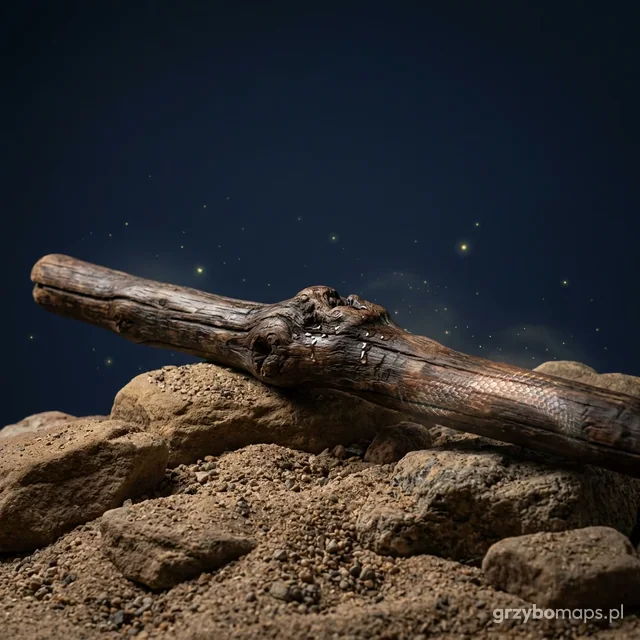
The Staff of Moses
The Bible (Old Testament)
This is how it looks in your profile
This artefact is waiting somewhere in the forest. When you find it while mushroom picking, its animated icon will light up in your Trophies, in the Artefact Display Case. Rare artefact gives 15 pts in the league.
The staff which, according to the Book of Exodus, Moses stretched out over the Red Sea when the waters parted before the Israelites. The same staff had earlier turned into a snake.
Origin
According to the Book of Exodus it was an ordinary shepherd's staff, which Moses held while tending the sheep of his father-in-law Jethro below Mount Horeb, when he heard a voice from the burning bush. Later Jewish tradition, including the “Pirke de-Rabbi Eliezer”, ascribed to it a miraculous origin reaching back to the beginning of the world.
History
At the burning bush Moses was afraid that Pharaoh and the people would not believe him. God told him to throw the staff on the ground, and it turned into a snake, from which Moses fled. When he seized it by the tail, the snake became a staff again. From that moment the Bible calls it the “staff of God”.
At Pharaoh's court the staff of Aaron, Moses's brother, also turned into a snake. The Egyptian sorcerers repeated the trick, but Aaron's staff swallowed their staffs. The staff was also struck on the waters of the Nile, which turned to blood, and so the plagues of Egypt began.
The most famous miracle happened by the sea. When Pharaoh's armies pinned the Israelites against the shore, Moses, at God's command, raised the staff and stretched out his hand over the sea. An east wind blew all night, the waters parted, and the people crossed on dry ground. When the Egyptians set off in pursuit, the waters returned to their place.
In the desert the staff gave life. Below Horeb Moses struck a rock with it and water gushed out. During the battle with the Amalekites at Rephidim he stood on a hill with the staff in his hand, and as long as he held his hands up, Israel prevailed. At Meribah, according to the Book of Numbers, instead of speaking to the rock he struck it twice, and for this lack of trust he did not enter the Promised Land.
Rabbinic legends add that the staff was created at twilight before the first Sabbath and passed from hand to hand from Adam through the patriarchs until it came to Jethro's garden. Only Moses managed to pull it out of the ground. In Islamic tradition the staff of the prophet Musa also turns into a snake, parts the sea and brings forth twelve springs from a rock.
How it works
According to the Book of Exodus, the staff worked when Moses used it at God's command: thrown to the ground it became a snake, stretched out over the sea it divided the waters, and struck against a rock it brought water out of it in the desert.
Powers
- Turning into a snake: Thrown on the ground it became a snake, and seized it was a staff again.
- Parting the sea: Raised over the sea, it heralded the parting of the waters, which let the Israelites pass.
- Water from the Rock: Striking the rock with the staff in the desert brought forth a spring for the thirsty people.
- Sign of victory: Raised in Moses's hands during the battle with the Amalekites, it gave Israel the advantage.
- Power by command: The staff worked only at God's command; it was not an instrument of magic in itself.
Fate
The Bible does not say what happened to the staff after the death of Moses. A staff that tradition attributes to Moses is among the relics in the Topkapı Palace in Istanbul, although its authenticity cannot be confirmed. It should not be confused with the bronze serpent or with Aaron's budding staff, which according to the Bible was kept in the Ark.
In culture
The scene of the parting of the sea with the staff in Moses's hand became an icon of cinema thanks to Cecil B. DeMille's 1956 film “The Ten Commandments” with Charlton Heston.
Fun fact
In the Topkapı Palace in Istanbul, among the relics, a staff is displayed which tradition attributes to Moses.