

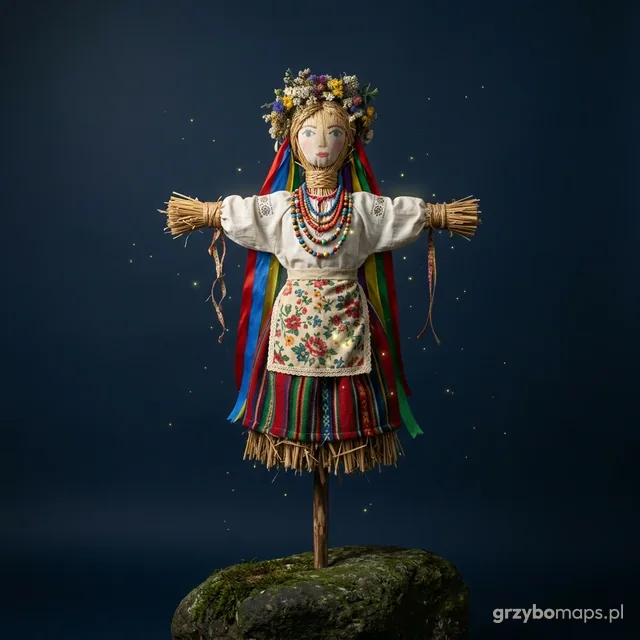
Marzanna effigy
Slavic rites
This is how it looks in your profile
This artefact is waiting somewhere in the forest. When you find it while mushroom picking, its animated icon will light up in your Trophies, in the Artefact Display Case. Common artefact gives 5 pts in the league.
Marzanna is a straw effigy symbolising winter, which is drowned or burned to welcome spring, today usually on 21 March. The custom derives from old Slavic rites and was already condemned by the Synod of Poznań in 1420.
Origin
Marzanna is a straw effigy of winter and death from the spring rites of the Western Slavs, also known as Śmiertka, Śmierć (Death) or Morena. The oldest Polish testimonies date from the 15th century: the custom was forbidden by the synod of the Poznań diocese in 1420, and Jan Długosz described Marzanna as a goddess.
History
In the past the rite took place not on 21 March but on the fourth Sunday of Lent, called in many regions the “death” or “white” Sunday. Young people made an effigy from straw and dressed it in a woman's rags, beads and ribbons, sometimes in a married woman's cap. Prepared like this, Marzanna became the embodiment of everything bad: winter, the hunger of the lean spring weeks, diseases and death itself.
The effigy was carried around the village with songs in which Death was driven out of the village. Then it was carried beyond the village boundary, to a river or pond, undressed, sometimes set on fire and thrown into the water. It was important that the water carried it away, because winter floated away with the effigy. On the way back one was not allowed to look behind, for whoever looked back might fall ill or draw Death back.
Right after the farewell to winter, spring was welcomed. A green branch or a small fir tree decorated with ribbons and blown eggshells, called a gaik or the “new summer” (nowy latek), was brought into the village, and people went with it from house to house singing. Death departed, and life returned.
For centuries the Church tried to ban this custom. The Poznań synod in 1420 ordered priests to make sure that on the mid-Lent Sunday “death” was not carried out and drowned in water. The rite nevertheless survived, and the chronicler Jan Długosz in the 15th century regarded Marzanna as an ancient Polish goddess, comparing her with the Roman Ceres. Some present-day scholars cautiously treat her rather as a ritual figure than a certain deity.
How it works
According to the rite, the effigy, dressed in women’s clothes and ribbons, was carried around the village with songs, and then burned or drowned in a river. With it winter, diseases and all evil were meant to depart. On the way home one was not allowed to look back, so as not to bring misfortune upon oneself.
Powers
- Driving out winter: According to belief, drowning or burning the effigy ended winter and opened the way for spring.
- Warding off disease: Plagues, hunger and death were to leave the village together with the effigy.
- The ban on looking back: Whoever looked behind them after the rite might draw misfortune or illness upon themselves.
- Summoning a bountiful harvest: Bidding Marzanna farewell and welcoming the gaik was meant to ensure fertile fields in the new year.
Fate
Marzanna effigies by their nature do not survive, because each one is drowned or burned. The custom is still alive in Polish schools and kindergartens on the first day of spring, although today drowning is often replaced by burning on the bank or by a symbolic farewell, so as not to litter the rivers.
In culture
Marzanna appears in many Polish poems and children's songs about the arrival of spring. Her Czech and Slovak counterpart, Morana, is the heroine of an identical rite there.
Fun fact
Jan Długosz in the 15th century described Marzanna (in his writing “Marzyana”) as a Polish goddess, the counterpart of the Roman Ceres.