

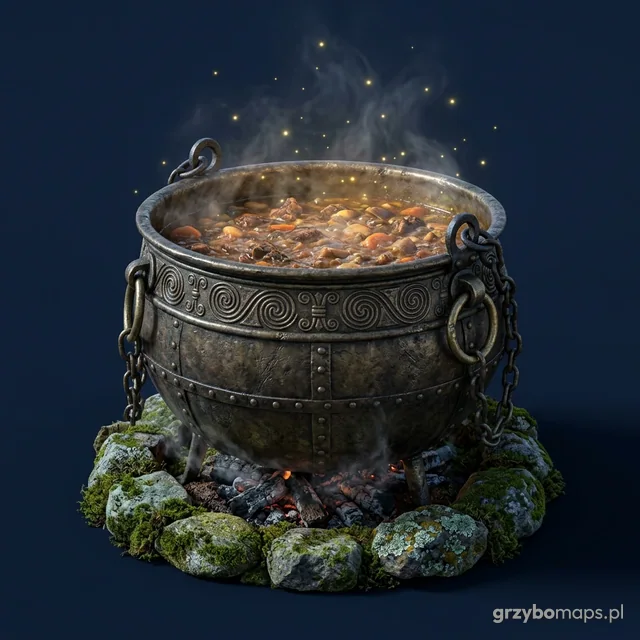
The Dagda's Cauldron
Celtic (Irish) mythology
This is how it looks in your profile
This artefact is waiting somewhere in the forest. When you find it while mushroom picking, its animated icon will light up in your Trophies, in the Artefact Display Case. Rare artefact gives 15 pts in the league.
The Dagda is an Irish god of druids, agriculture and abundance, whose attributes were a club and a cauldron. His cauldron was bottomless and could feed an entire army.
Origin
The cauldron belonged to the Dagda, the “good god” and father of the tribe of gods, the Tuatha Dé Danann. According to medieval Irish texts, above all the “Book of Invasions” (Lebor Gabála Érenn, 11th century) and the tale of the four treasures, the gods brought it from Murias, one of the four cities in the north of the world, where the sage Semias taught them.
History
The Tuatha Dé Danann came to Ireland from the mysterious islands of the north, from four cities: Falias, Gorias, Murias and Findias. In each they gained knowledge and magic from a different master, and from each they took one treasure. From Falias they brought the Lia Fáil stone, from Gorias the spear of Lugh, from Findias the sword of Nuada, and from Murias the cauldron of the Dagda.
The Dagda was a mighty, wise and somewhat bawdy god. He had three famous objects: a cauldron from which no one went away hungry, a huge club that killed with one end and restored life with the other, and a harp whose music summoned the seasons. The cauldron was the sign of his role as provider and guardian of the tribe.
Before the second battle of Mag Tuired, told in the medieval text “Cath Maige Tuired”, the Fomorians decided to mock the Dagda with his own appetite. They poured an enormous amount of porridge with milk, meat and fat into a great pit in the ground and threatened him with death if he did not eat it. The Dagda seized a ladle so big that a pair of people could fit in it, ate everything down to the bottom, and then fell asleep with a full belly.
Cauldrons of abundance and rebirth are known to other Celtic peoples as well. In the Welsh “Branwen, Daughter of Llyr” from the Mabinogion there is a cauldron that restores life to slain warriors, though they rise from it mute. Some scholars see in such cauldrons distant ancestors of the Grail, the miraculous vessel that feeds and heals.
How it works
The cauldron was one of the four treasures of the gods of the Tuatha Dé Danann, brought from the city of Murias. According to a medieval text, no one left it unsatisfied, because the food in it never ran out. It was called “coire ansic”, the cauldron that never runs dry.
Powers
- Inexhaustible food: The cauldron never ran empty, so it could feed any number of guests.
- No one goes away hungry: According to the text about the four treasures, everyone who approached it went away satisfied.
- Gift from Murias: It was one of the four treasures of the gods and proof of their supernatural origin.
- Sign of hospitality: The cauldron expressed the ruler's duty to feed his people, which in Ireland was a royal virtue.
Fate
No tale says outright what became of the cauldron when the Tuatha Dé Danann, after their defeat by the sons of Míl, withdrew into the underground mounds known as the sídhe. Tradition says they took their treasures there with them. Real Celtic ritual cauldrons, such as the silver cauldron from Gundestrup, can be seen in museums today.
In culture
The Dagda and his cauldron appear in modern fantasy, and a similar cauldron from Welsh legends inspired Lloyd Alexander's novel “The Black Cauldron” (1965), on which Disney's film “The Black Cauldron” (1985) was based.
Fun fact
The most famous Celtic cauldron, the silver Gundestrup cauldron, was found in 1891 in a peat bog in Denmark. It is kept in the National Museum in Copenhagen.