

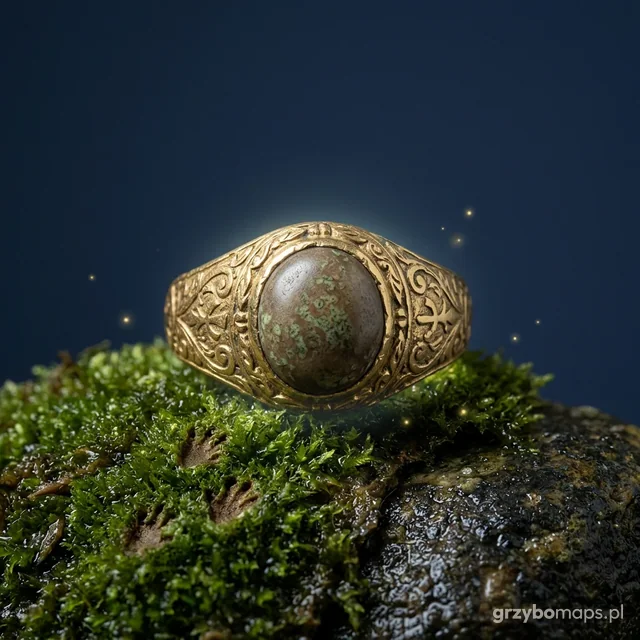
Toadstone
Middle Ages
This is how it looks in your profile
This artefact is waiting somewhere in the forest. When you find it while mushroom picking, its animated icon will light up in your Trophies, in the Artefact Display Case. Common artefact gives 5 pts in the league.
A stone that, according to medieval beliefs, was lodged in the head of an old toad. It was set in rings and amulets worn until the 18th century.
Origin
Belief in a stone from the head of a toad was alive in medieval and early modern Europe, especially in England, Scotland and the German lands. It was described by authors of natural-history encyclopaedias, and rings with “toadstones” were worn from the Middle Ages to the 18th century. In Latin it was called “bufonites”, from “bufo”, a toad.
History
According to belief the stone grows in the head of a very old toad as its most precious treasure. The toad was regarded as a venomous creature, so it was reasoned that since it lives with poison it must also carry an antidote within. The stone was said to be dark, brown or grey, smooth and round like a button.
Extracting it required cunning. The English naturalist Edward Topsell in the 17th century described how the stone had to be taken from a living old toad by laying it on red cloth. It was believed that a dead toad would manage to swallow the stone or rob it of its power.
The stone was set in gold and silver rings so that it touched the skin. When poison was nearby, it was supposed to grow warm or change colour, warning the owner. It was also rubbed on insect and snake bites, in the belief that it drew out the venom. Scottish and English owners passed such rings down from generation to generation.
In the comedy “As You Like It”, Shakespeare has Duke Senior say that sweet are the uses of adversity, which, like the toad, ugly and venomous, wears yet a precious jewel in its head. Today it is known that “toadstones” are fossilised, button-like teeth of extinct fish of the genus Scheenstia (formerly Lepidotes), with which these fish crushed shells in the Jurassic and Cretaceous.
How it works
It was believed that the stone protects against poison: near poison it was said to heat up or change colour. Because a toad's skin secretes a poisonous slime, people thought it also carries an antidote within itself.
Powers
- A warning of poison: A ring with the stone was supposed to grow warm or change colour near poisoned food.
- Drawing out venom: Applied to bites, it was supposed to suck out the venom of snakes and insects.
- The power of the antidote: It was believed that the toad, itself venomous, carries within it a cure for every poison.
- A family talisman: Rings with the stone were passed on to children as protection and a treasure of the family.
Fate
Rings with “toadstones” have survived in museums, among them the National Museums Scotland in Edinburgh. The fossilised fish teeth from which they were made are still found in the Jurassic rocks of England.
In culture
The quotation from “As You Like It” about the jewel in the toad's head is one of the most frequently cited in English literature. The motif of a stone in a toad's head also appears in medieval bestiaries and illustrations.
Fun fact
The real “toadstones” are fossilised teeth of an extinct fish of the genus Lepidotes, which lived in the Jurassic and Cretaceous. Shakespeare mentions it in the comedy “As You Like It”.