

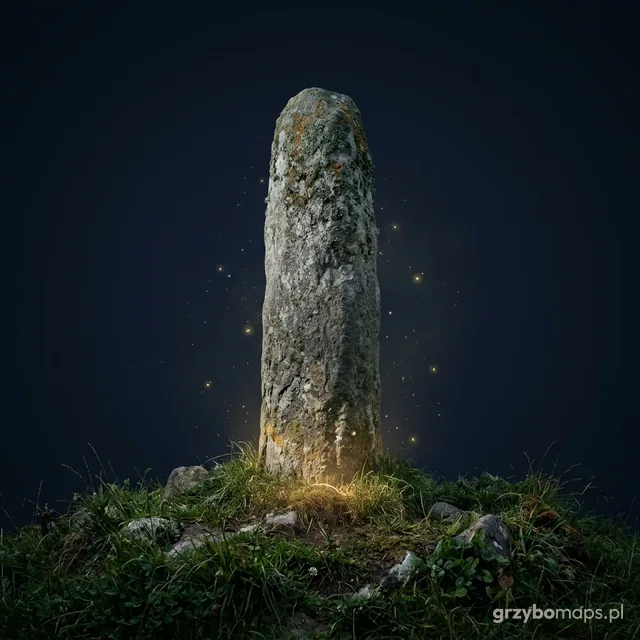
Stone of Destiny
Celtic (Irish) mythology
This is how it looks in your profile
This artefact is waiting somewhere in the forest. When you find it while mushroom picking, its animated icon will light up in your Trophies, in the Artefact Display Case. Legendary artefact gives 50 pts in the league.
Lia Fáil, the “Stone of Destiny”, is the coronation stone of the kings of Ireland on the Hill of Tara. According to the myths, the gods of the Tuatha Dé Danann brought it from the city of Falias as one of their four treasures.
Origin
Lia Fáil, the “Stone of Destiny”, is the stone from Falias, one of the four cities from which the gods of the Tuatha Dé Danann brought their treasures. It is described by medieval Irish texts, among them the “Book of Invasions” (11th century), and from it comes the poetic name of Ireland, Inis Fáil, the “Island of Fál”.
History
When the Tuatha Dé Danann took possession of Ireland, they set up the stone from Falias on the Hill of Tara, the seat of the high kings. From then on every claimant to the throne had to stand on it. If he was the rightful ruler, the stone gave a loud cry, audible throughout the land. If it stayed silent, the land did not accept the king.
The most famous tale concerns Cú Chulainn, the greatest hero of Ulster. His foster-son Lugaid stood on the stone, and it gave no voice. Enraged, Cú Chulainn struck it with his sword and split it. From that day the stone fell silent under all kings, with one exception: it cried out once more under Conn of the Hundred Battles, the legendary ancestor of many Irish dynasties.
In another tale, linked with Conn, the stone cried out beneath his feet, and the druids counted the cries and read from them how many of his descendants would rule over Ireland. The prophecy was meant to show that power comes not from strength alone but from the verdict of the land itself.
The Scots have their own story. According to their tradition the Stone of Destiny travelled from Ireland to Scotland and became the coronation stone at Scone, and a later legend even linked it with the stone on which the biblical Jacob fell asleep and saw the ladder to heaven. It is only a tale: historians regard the Stone of Scone as a piece of local sandstone, and the Irish Lia Fáil still stands at Tara.
How it works
The stone cried out when the rightful king of Ireland stood on it, and stayed silent under anyone else. When it did not call out under Cú Chulainn's foster-son Lugaid, the enraged hero split it with his sword. From then on it cried out under only one more king, Conn of the Hundred Battles.
Powers
- The voice of the rightful king: The stone cried out beneath the feet of the true ruler of Ireland and stayed silent under anyone else.
- Prophecy of a dynasty: The number of its cries was supposed to foretell how many descendants of the king would take power.
- A gift from Falias: It was one of the four treasures of the gods, brought from the wondrous city of the north.
- Falling silent: After Cú Chulainn's blow it lost its voice, which the legend explains as a punishment for the hero's anger.
Fate
The Irish Lia Fáil stands to this day on the Hill of Tara, to which it was moved in 1824 from the Mound of the Hostages to commemorate those who fell in the Battle of Tara during the 1798 rising. The Scottish Stone of Scone survived being seized by Edward I in 1296 and being stolen from Westminster Abbey by Scottish students at Christmas 1950. It returned to Scotland in 1996, in 2023 it was used at the coronation of Charles III, and since 2024 it has been in the Perth Museum.
In culture
The theft of the Stone of Scone in 1950 is told in the British film “Stone of Destiny” (2008).
Fun fact
The Irish Lia Fáil still stands on the Hill of Tara, and the Scots also call the Stone of Scone, on which their kings were crowned, the “Stone of Destiny”. Edward I carried it off to London in 1296, and since 2024 it can be seen in the Perth Museum in Scotland.