

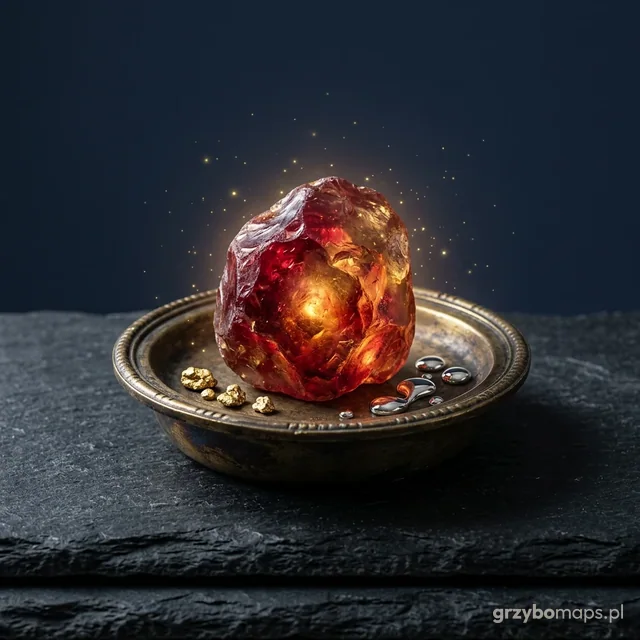
Philosopher’s stone
alchemia
This is how it looks in your profile
This artefact is waiting somewhere in the forest. When you find it while mushroom picking, its animated icon will light up in your Trophies, in the Artefact Display Case. Legendary artefact gives 50 pts in the league.
A legendary substance sought by alchemists, said to turn base metals into noble ones and make it possible to prepare the elixir of life. A famous Polish alchemist was Michał Sędziwój, author of “Novum Lumen Chymicum” (1604).
Origin
The idea of a substance that transmutes metals appears in Greek alchemy from Egypt, in Zosimos of Panopolis (c. AD 300). It was developed by Arab alchemists, among them the authors of writings attributed to Jabir ibn Hayyan, and in the 12th century it reached Latin Europe, where it was called “lapis philosophorum”, the stone of the wise.
History
Alchemists believed that all metals ripen in the earth towards the perfection of gold, and that the philosopher's stone could speed up this process. To obtain it one had to go through the “Great Work” in successive stages named after colours: blackening (nigredo), whitening (albedo), yellowing (citrinitas) and reddening (rubedo). The finished stone was usually described as a red powder or a heavy crystal.
The most famous legend is the story of Nicolas Flamel, a Parisian scribe of the 14th century. According to tales written down only in the 17th century, he bought a mysterious book of Abraham the Jew, searched for years for its key and in 1382 turned mercury into gold. Flamel's endowments for churches and hospitals were supposed to be the fruit of the stone, and to this day a rumour circulates that he did not die at all.
The Polish hero of this story is Michał Sędziwój (1566 to 1636). According to tradition he helped free the Scottish alchemist Alexander Seton, known as the Cosmopolite, from a Saxon prison, and received from him a mysterious powder of transmutation. It is told that he demonstrated transmutation at the court of Emperor Rudolf II in Prague, and his “Novum Lumen Chymicum” (1604) was read by alchemists throughout Europe.
Sędziwój also worked for King Sigismund III Vasa, who was himself interested in alchemy. According to tradition an explosion in the royal alchemical laboratory caused the fire of Wawel in the mid-1590s, and some even linked to it the move of the court to Warsaw, which historians do not confirm. Isaac Newton and many rulers also hunted for the philosopher's stone, but no one ever presented real proof.
How it works
According to the alchemists, a pinch of the stone thrown onto molten lead or mercury turned it into gold or silver. Dissolved in wine, it was said to cure diseases and prolong life. Only one who had gone through the entire “Great Work” of alchemy could obtain it.
Powers
- Transmutation of metals: A pinch of the stone thrown onto molten lead or mercury was supposed to turn it into silver or gold.
- A cure for everything: Dissolved in a drink, it was supposed to cure diseases and restore strength, hence the link with the elixir of life.
- Prolonging life: Alchemists believed that the owner of the stone could live much longer than ordinary people.
- Perfecting the soul: In the symbolic view, the Great Work also meant the transformation and purification of the alchemist himself.
Fate
The philosopher's stone has never been found, and modern chemistry has explained that the transmutation of elements occurs only in nuclear reactions. At Wawel the traditional site of the alchemical laboratory is shown, and Sędziwój made his mark in the history of science with his descriptions of a “food of life” in the air, linked to oxygen.
In culture
J.K. Rowling's novel “Harry Potter and the Philosopher's Stone” (1997, Polish edition 2000) made the stone and Nicolas Flamel figures known to millions of readers. Sędziwój was portrayed by Jan Matejko in the painting “The Alchemist Sędziwój” (1867).
Fun fact
Michał Sędziwój is considered a precursor of the discovery of oxygen: he wrote that the air contains a hidden substance essential for life. His work was published dozens of times in Europe.