

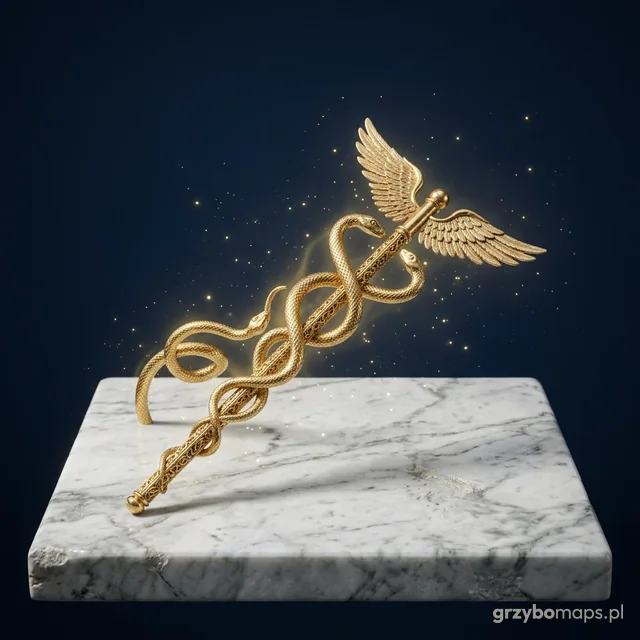
Caduceus
mitologia grecka
This is how it looks in your profile
This artefact is waiting somewhere in the forest. When you find it while mushroom picking, its animated icon will light up in your Trophies, in the Artefact Display Case. Rare artefact gives 15 pts in the league.
The golden staff of a herald, entwined with two serpents and topped with little wings, an attribute of Hermes, messenger of the gods. According to myth, Hermes received it from Apollo when they exchanged gifts.
Origin
The caduceus, in Greek kerykeion, that is, the herald's staff, is an attribute of Hermes. The Homeric “Hymn to Hermes” of the 6th century BC describes how Apollo gave him a golden staff of wealth and prosperity, and the tale of the serpents was recorded by the Roman author Hyginus in the “Astronomica”.
History
Hermes was born at dawn in a cave on Mount Kyllene in Arcadia, and by afternoon he had slipped out of his cradle. He made a lyre from a tortoise shell, and in the evening stole fifty cows from Apollo, driving them backwards so the tracks would mislead pursuit. When the matter came to light, Zeus ordered him to return the herd, but Apollo was so delighted by the sound of the lyre that he proposed an exchange.
Apollo received the lyre, and Hermes the golden staff and the office of divine messenger. According to Apollodorus, Hermes later also made a shepherd's pipe and gave it to Apollo in return for the same staff. From then on Hermes carried news between Olympus, the earth and the underworld, and was the patron of merchants, travellers, shepherds, and also thieves.
Hyginus relates that as Hermes was crossing Arcadia, he saw two snakes fighting each other. He laid his staff between them, and the snakes stopped fighting and coiled around it. For this reason the staff with snakes became a sign of peace, and heralds who carried it in wartime could pass safely between hostile camps.
In the “Iliad” and the “Odyssey”, Hermes uses his staff to close people's eyes in sleep or to wake the sleeping. In Book 24 of the “Odyssey” he leads with it the souls of Penelope's slain suitors to Hades, and they follow him squeaking, like bats in a cave. With the same staff he guided old Priam, unseen, through the Greek camp to Achilles' tent, where the king ransomed the body of Hector.
How it works
According to myth, the caduceus reconciles those at odds: when Hermes laid the staff between two fighting snakes, they stopped fighting and coiled around it. With this staff the god puts people to sleep and wakes them, and also leads the souls of the dead to Hades. A herald who carried the caduceus was inviolable even to enemies.
Powers
- Reconciling the quarrelling: Laid between combatants, it calms them and ends the dispute.
- Sleep and waking: With it Hermes closes people's eyes in sleep or wakes them.
- Guide of souls: With the staff Hermes leads the souls of the dead to the underworld.
- Inviolability of the envoy: A herald with a caduceus was protected by law and must not be harmed.
- Wealth and prosperity: In the “Hymn to Hermes” the staff safeguards success and good fortune in business.
Fate
The caduceus survived as a symbol of trade, the post and diplomacy; it appears, among other places, in the emblems of chambers of commerce and customs. Since the 16th century, and especially since 1902, when the US Army medical corps adopted it, it has been wrongly used as a sign of medicine instead of the rod of Asclepius.
In culture
Mercury with a caduceus is shown in Giambologna's famous bronze sculpture in Florence (Museo del Bargello).
Fun fact
The caduceus is often confused with the staff of Asclepius, the symbol of medicine. In 1902 it found its way into the insignia of the US Army Medical Corps, which greatly spread this mistake.