

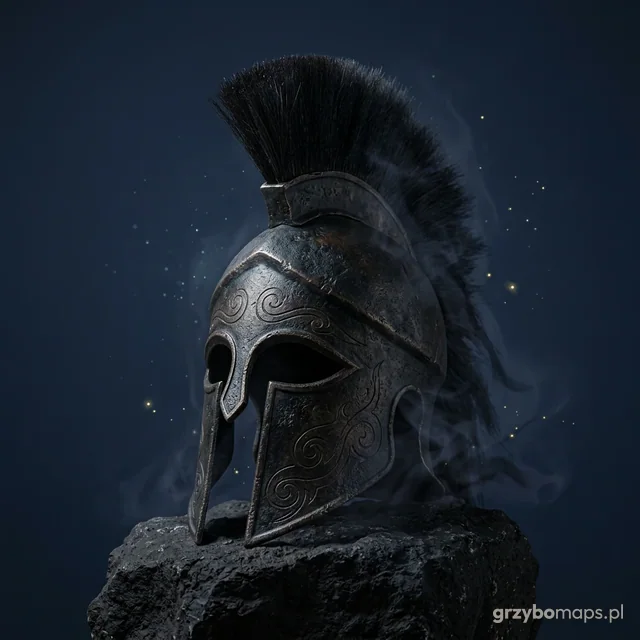
Helm of Hades
mitologia grecka
This is how it looks in your profile
This artefact is waiting somewhere in the forest. When you find it while mushroom picking, its animated icon will light up in your Trophies, in the Artefact Display Case. Rare artefact gives 15 pts in the league.
The helmet of the god of the underworld, made by the Cyclopes, which made its wearer invisible. With it Perseus managed to escape the Gorgons after killing Medusa.
Origin
The helmet, called kyneē in Greek, belonging to Hades, was forged by the Cyclopes during the Titanomachy, the war of the young gods against the Titans. It is already mentioned by Homer in the “Iliad” (8th century BC), and the full story of its making is given by the “Bibliotheca” attributed to Apollodorus (1st or 2nd century AD).
History
Cronus, ruler of the Titans, kept the Cyclopes locked in Tartarus. When Zeus and his siblings declared war on him, the oracle of Gaia promised them victory if they freed the prisoners. The grateful Cyclopes forged three gifts: a thunderbolt for Zeus, a trident for Poseidon, and for Hades a helmet that cloaked its wearer in darkness. According to Apollodorus, it was thanks to these three weapons that the gods defeated the Titans.
Hades rarely left his realm, so the helmet often passed into other hands. In the “Iliad” Athena put it on to support Diomedes invisibly against Ares, and the god of war did not even notice her until Diomedes' spear wounded him in the belly. During the battle of the gods with the giants, Hermes wore the helmet and, according to Apollodorus, killed the giant Hippolytus in it.
The most famous borrower was Perseus. The Grey Sisters, the Graeae, who shared one eye and one tooth among the three of them, showed him the way to the nymphs, and the nymphs gave him winged sandals, the kibisis bag and the helmet of Hades. After the beheading of Medusa, her sisters, the immortal Gorgons, gave chase, but could not see the hero. The poem “Shield of Heracles” of the 6th century BC describes Perseus, around whom the helmet spreads “the fearful darkness of night”.
The helmet also appears in philosophy. In the “Republic”, Plato sets the ring of Gyges and the helmet of Hades side by side as two objects that allow one to do anything without witnesses, and asks whether a just man should make use of them. The ancients linked the name of Hades, Aides, with the word for “invisible”, though modern linguists consider that explanation uncertain.
How it works
According to the myth, the Cyclopes forged it for Hades in gratitude for freeing them from Tartarus, just like the thunderbolt for Zeus and the trident for Poseidon. Whoever puts it on becomes invisible even to the gods. Heroes also made use of it: Perseus received the helmet from the nymphs, together with winged sandals and a bag for Medusa’s head.
Powers
- Invisibility: Whoever puts it on becomes invisible to humans, monsters, and even gods.
- Cloak of darkness: The helmet surrounds its wearer with the gloom of night, in which no one can spot him.
- A weapon of the Titanomachy: It was one of the three gifts of the Cyclopes that decided the gods' victory over the Titans.
- Escaping pursuit: It allowed Perseus to escape the immortal Gorgons.
Fate
According to Apollodorus, after his expedition Perseus gave the sandals, the bag and the helmet to Hermes, who returned them to the nymphs. After that the helmet vanishes from the myths, and there is no tradition of its destruction or hiding.
In culture
In Rick Riordan's novel “Percy Jackson and the Olympians: The Lightning Thief” (2005), the stolen helm of darkness of Hades is, alongside Zeus's lightning bolt, one of the key objects of the plot.
Fun fact
In Homer’s “Iliad” the goddess Athena put on the helmet of Hades so that the god of war, Ares, would not see her on the battlefield at Troy.