

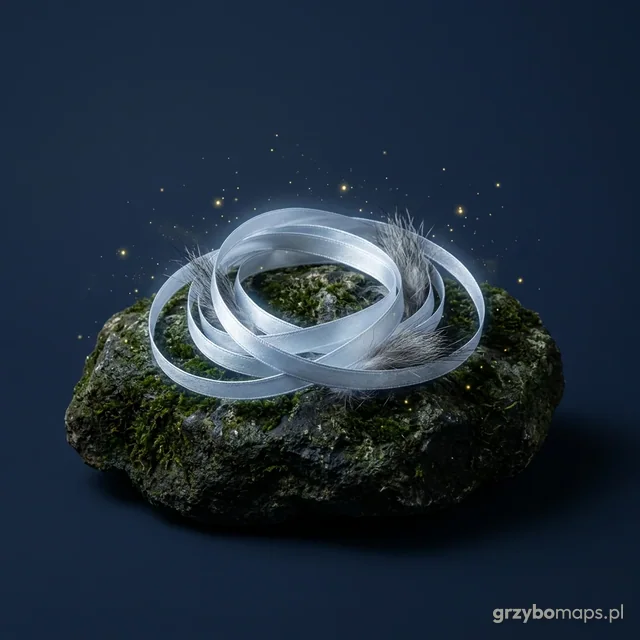
Gleipnir
mitologia nordycka
This is how it looks in your profile
This artefact is waiting somewhere in the forest. When you find it while mushroom picking, its animated icon will light up in your Trophies, in the Artefact Display Case. Rare artefact gives 15 pts in the league.
The magic fetter with which the gods bound the wolf Fenrir after he broke the iron chains Læding and Dromi. It was made by dwarves, and it was thin and soft as a silk ribbon.
Origin
Gleipnir was made by dwarfs in Svartálfaheim, the land of the black elves, at the request of Odin, who sent his messenger Skírnir to them. The whole story is told by Snorri Sturluson in the “Prose Edda” (c. 1220), and older poems of the “Poetic Edda” already mention the bound wolf.
History
Fenrir was the son of Loki and the giantess Angrboda. The gods raised him in Asgard, because prophecies said he would bring about their doom, but the wolf grew so fast and so fearsome that only the brave Tyr dared to feed him. So they decided to bind him, pretending it was only a test of strength.
First they brought the iron chain Løding. Fenrir flexed his muscles and snapped it with ease. Then they forged Dromi, twice as strong, and that broke too, the links flying far and wide. Snorri writes that this is the origin of the Icelandic sayings about “breaking free from Løding” and “getting loose from Dromi”, said when someone achieves something with enormous effort.
Then the dwarfs wove Gleipnir from six things that do not exist: the sound of a cat's footfall, the beard of a woman, the roots of mountains, the sinews of a bear, the breath of a fish and the spittle of a bird. The result was a ribbon smooth and soft as silk. The gods took the wolf to the island of Lyngvi in the lake Ámsvartnir and proposed another game.
Fenrir suspected a trick: a ribbon so thin either means nothing or is enchanted. He agreed to be bound only if one of the gods put a hand in his mouth as a sign of good faith. Only Tyr did so. The harder the wolf struggled, the tighter the bonds drew, and the gods laughed, all except Tyr, who lost his hand.
The gods fastened Gleipnir to a rock deep in the earth, and drove a sword into the wolf's mouth so that he could not bite. The slaver that runs from it forms the river Ván, that is, “Hope”. So Fenrir waits until Ragnarök, when he will break his bonds and devour Odin.
How it works
According to Snorri, Gleipnir was woven from six impossible things: the sound of a cat's footfall, a woman's beard, the roots of mountains, the sinews of a bear, the breath of a fish and the spittle of a bird. The harder Fenrir struggled, the tighter it held him. The wolf agreed to it only when the god Tyr put his hand in the wolf's jaws, and when the fetter held, Fenrir bit off Tyr's hand.
Powers
- Unbreakable: The bonds withstood the strength of a wolf who easily snapped the strongest iron.
- The harder, the tighter: Every tug of Fenrir only tightened the ribbon more.
- Woven from the impossible: Six ingredients that do not exist in the world make it stronger than any material.
- Seeming fragility: It looked like a silk ribbon, so its power was hidden from the enemy.
Fate
According to the myth, Gleipnir holds Fenrir until the end of the world, and then it will snap and the wolf will go against the gods. The same prophecy of the wolf who will break his bonds is repeated in the “Völuspá” from the “Poetic Edda”.
In culture
The bonds gave their title to the Japanese manga “Gleipnir” by Sun Takeda, adapted as an anime in 2020, and Fenrir and his bonds appear in many fantasy novels and games.
Fun fact
Snorri jokes that this is exactly why these things no longer exist: a cat walks soundlessly, women have no beards, and mountains have no roots.