

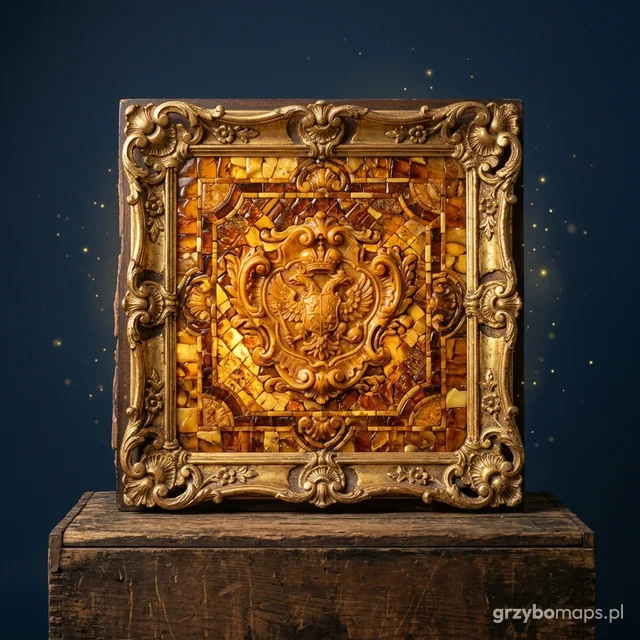
Fragment of the Amber Room
history and legend
This is how it looks in your profile
This artefact is waiting somewhere in the forest. When you find it while mushroom picking, its animated icon will light up in your Trophies, in the Artefact Display Case. Rare artefact gives 15 pts in the league.
The Amber Room, made to the order of the Prussian king Frederick I, passed to Tsar Peter I and adorned the palace at Tsarskoye Selo. In 1941 the Germans looted it and took it to Königsberg, where all trace of it was lost.
Origin
The chamber was designed by Andreas Schlüter on the commission of the Prussian king Frederick I, and from 1701 it was made by, among others, Gottfried Wolfram and the Gdańsk masters Ernst Schacht and Gottfried Turau. In 1716 King Frederick William I presented it to Tsar Peter I as a sign of the alliance against Sweden.
History
The Amber Room was meant to be a wonder of the Baroque: walls of thousands of fitted pieces of amber, gilded ornaments, mirrors and mosaics. Tsar Peter I was delighted with it during a visit to the Prussian king, and Frederick William I, who valued soldiers and alliances more than art, gave it to him in 1716.
In 1755 the Empress Elizabeth moved the chamber to the Catherine Palace in Tsarskoye Selo near St Petersburg. Bartolomeo Rastrelli enlarged it and added new elements. For almost two centuries it was regarded as the “eighth wonder of the world”.
In 1941 the Germans entered Tsarskoye Selo. Within a few dozen hours they dismantled the chamber, packed it into crates and took it to Königsberg, where it was put on display in the castle. In 1944 the city was bombed, and in 1945 it was captured by the Red Army. Since then the trail of the chamber has been lost.
A great hunt began. Some believed the crates burned in the castle, others that they were hidden in mines, bunkers or sunk on a ship. Searches were made in Germany, Russia, the Czech Republic and Poland, including the bunkers in Mamerki in Masuria. In 1997 in Bremen one of the four Florentine mosaics of the chamber was found, which returned to Russia in 2000.
How it works
According to legends, the crates with the room were hidden in cellars or bunkers, and the people guarding the secret took it to their graves. Treasure hunters also searched for it in Poland, among other places in the bunkers at Mamerki in Masuria and in the cellars of Książ Castle. Nothing was found, so this fragment of amber is pure fantasy.
Powers
- The glow of amber: According to descriptions, the hall shone with a warm, golden light, and for many it was the most magnificent room in the world.
- Curse of the seekers: Stories have grown up around the chamber of mysterious deaths of people who were supposed to know where the treasure was hidden.
- Gift of alliance: Historically it was a diplomatic gift that sealed the alliance of Prussia and Russia.
- Eternal mystery: It remains one of the greatest unsolved mysteries of the Second World War.
Fate
The original is considered lost, and most researchers believe it burned in Königsberg in 1945. In 2003 a faithful reconstruction was opened in Tsarskoye Selo, and the search still goes on.
In culture
The mystery of the chamber appears in documentaries and novels, including Steve Berry's thriller “The Amber Room” (2003).
Fun fact
From 1701 the work on the room was carried out by, among others, amber-workers from Gdańsk, including Gottfried Turau. A faithful reconstruction was opened at Tsarskoye Selo in 2003.