

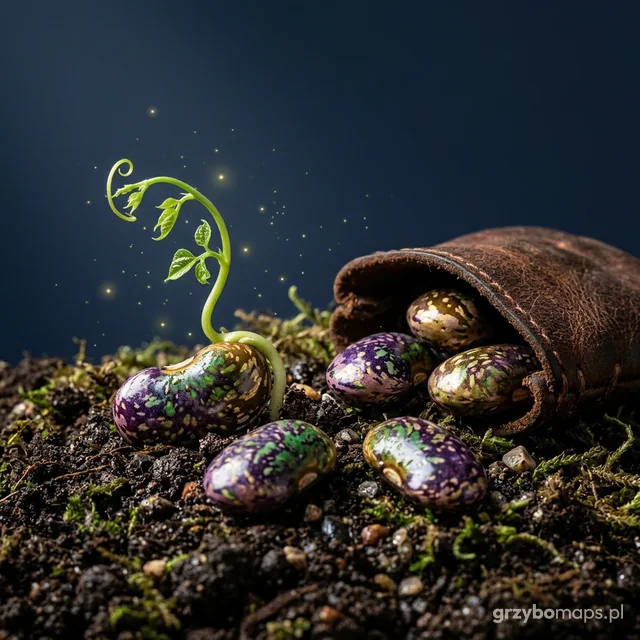
Jack’s beans
English fairy tale
This is how it looks in your profile
This artefact is waiting somewhere in the forest. When you find it while mushroom picking, its animated icon will light up in your Trophies, in the Artefact Display Case. Rare artefact gives 15 pts in the league.
The magic seeds from the English fairy tale “Jack and the Beanstalk”. Poor Jack traded a cow for them, and his angry mother threw them out of the window.
Origin
The bean comes from the English fairy tale “Jack and the Beanstalk”. The oldest known printed version is the satirical “The History of Jack Spriggins and the Enchanted Bean” of 1734, the first full version was published by Benjamin Tabart in 1807, and the most popular was written down by Joseph Jacobs in “English Fairy Tales” (1890).
History
Jack lives with his poor mother, and their only possession is a cow, Milky-White, who has stopped giving milk. His mother sends him to market with her. On the way Jack meets a strange old man, who offers him five miraculous beans for the cow. Jack agrees, and his mother, furious, throws the beans out of the window and sends her son to bed without supper.
In the morning a thick stalk stands outside the window, which has grown overnight right up to the sky. Jack climbs up and finds a long road to a great house. The giant's wife hides him in the oven when her husband returns, calling out: “Fee-fi-fo-fum, I smell the blood of an Englishman!” After dinner the giant counts his gold and falls asleep, and Jack runs off with a bag of coins.
Jack returns twice more. The second time he carries off a hen that lays a golden egg at the word “lay”. The third time he takes a golden harp that plays by itself. The harp, however, cries “Master! Master!” and wakes the giant, who sets off after Jack down the stalk.
Jack climbs down first, calls his mother to hand him the axe, and chops down the stalk. The giant falls and dies on the spot, and the stalk topples over. Jack and his mother live comfortably from then on thanks to the golden eggs and the playing harp. In Tabart's moralising version a fairy explains that the giant once killed Jack's father and stole his treasures, so the boy is only recovering the family fortune.
How it works
In a single night a stalk reaching the sky grows from the seeds. Jack climbs it to the giant’s castle and carries off a bag of gold, a hen that lays golden eggs and a singing harp. At the end he chops down the stalk, and the giant chasing him falls to his death.
Powers
- Stalk to the sky: The discarded seeds grow in a single night into a stalk reaching the land above the clouds.
- The way to the giant: The stalk leads to the giant's house full of treasures, inaccessible to ordinary people.
- One-time passage: Once the stalk is chopped down with an axe, the link to the heavenly land vanishes for ever.
- Swap for fortune: The seeds look worthless, but in exchange for a cow they give the family wealth for life.
Fate
The stalk was cut down, and the remaining beans are no longer in the tale. The researchers Jamshid Tehrani and Sara Graça da Silva estimated in 2016, using statistical methods, that the tale type about the boy who steals a giant's treasures (no. 328 in the ATU tale-type catalogue) may be more than 5000 years old, although this is a conclusion from a model, not a document.
In culture
The giant's cry already appears in Shakespeare's “King Lear” (“Fie, foh, and fum, I smell the blood of a British man”). The tale has become many pantomimes, films and games, and in Poland it was published as “Jaś i magiczna fasola” (“Jack and the Magic Bean”).
Fun fact
The most frequently reprinted version of the tale was published by Joseph Jacobs in his collection “English Fairy Tales” (1890). The story had been known in England for over a hundred years before that.