

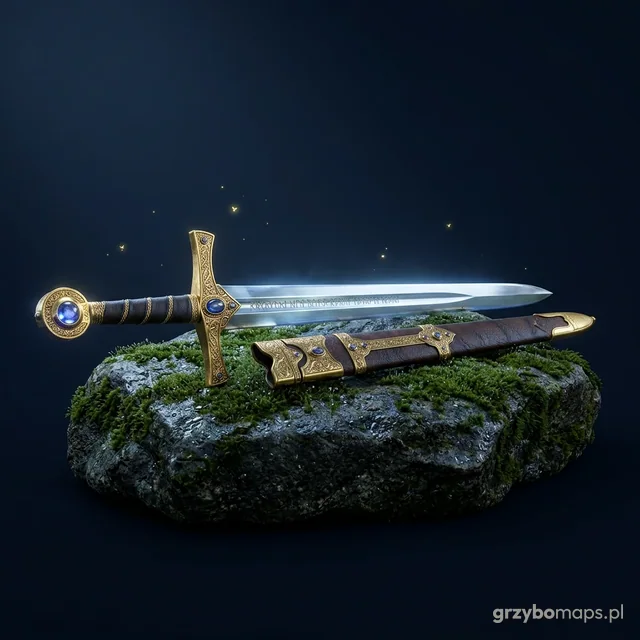
Excalibur
Arthurian legends
This is how it looks in your profile
This artefact is waiting somewhere in the forest. When you find it while mushroom picking, its animated icon will light up in your Trophies, in the Artefact Display Case. Legendary artefact gives 50 pts in the league.
The legendary sword of King Arthur, also called Caliburn. In Malory's “Le Morte d'Arthur” it is handed to the king by the Lady of the Lake.
Origin
The oldest form of the sword is the Welsh Caledfwlch, mentioned in the tale “Culhwch and Olwen” (c. 1100). Geoffrey of Monmouth in the “History of the Kings of Britain” (c. 1136) called it Caliburnus and wrote that it was forged on the isle of Avalon, and French romances and Thomas Malory (1485) fixed the name Excalibur and the figure of the Lady of the Lake.
History
In Geoffrey of Monmouth, Caliburnus is simply the best sword of the king of the Britons. In the battle of Badon, Arthur, calling on the name of the Blessed Virgin Mary, charges with it into the ranks of the Saxons and, as the chronicler claims, personally fells four hundred and seventy enemies. The sword became the sign of a king who defends his land.
Thomas Malory is already telling a fairy tale. The sword drawn from the stone by young Arthur breaks in a fight with King Pellinore. The wizard Merlin then leads the king to a lake, where an arm clothed in white silk rises from the water, holding a sword in its hand. The Lady of the Lake gives it to Arthur in return for a future favour. Merlin asks which the king values more, the sword or the scabbard. Arthur chooses the sword, and Merlin chides him, for the scabbard is ten times more precious: whoever wears it does not bleed from wounds.
The greatest threat to Excalibur turned out to be Arthur's sister, the sorceress Morgan. She steals the sword and gives it to her lover Accolon, who faces the king in a duel while Arthur is armed with a forged copy. Arthur, bleeding, finally recovers his weapon, but Morgan steals the scabbard and hurls it into a lake. From then on the king is no longer invulnerable.
In the last battle at Camlann, Arthur kills the traitor Mordred but is himself mortally wounded. He orders his knight Bedivere to throw Excalibur into the water. Twice Bedivere hides the sword, because he is sorry to part with such a treasure, and twice he lies that he saw nothing. Only the third time does he truly throw it, and from the lake a hand rises, seizes the sword, brandishes it three times and vanishes into the depths. Then a boat with black-clad queens carries Arthur to Avalon.
It is worth knowing that the traditions differ. In some medieval texts the sword from the stone and the sword from the lake are one blade, while in Malory they are clearly two different ones. In many later tales and films the two threads have merged into a single story about Excalibur.
How it works
According to Malory, the drawn sword shone in the eyes of enemies like thirty torches. Even more precious was the scabbard: whoever wore it lost no blood from their wounds. The dying Arthur ordered Excalibur to be thrown into the lake, and a hand rose from the water and caught it.
Powers
- The gleam of thirty torches: The drawn sword shone so brightly that it blinded opponents.
- Scabbard against bleeding: The owner of the scabbard did not lose blood, even if gravely wounded.
- Sword from Avalon: According to Geoffrey, it was forged on an enchanted island, which made it a weapon from another world.
- Sign of the rightful king: The sword belonged to Arthur by the will of the Lady of the Lake and had to return to her when his reign ended.
Fate
According to legend, Excalibur rests on the bottom of the lake under the care of the Lady of the Lake, and the scabbard was lost earlier through Morgan. Tradition links several bodies of water in Great Britain with the place where the sword was sunk, for example the pool Dozmary Pool in Cornwall. No historical sword has ever been recognised as Excalibur.
In culture
The sword gave its title to John Boorman's film “Excalibur” (1981), and the Lady of the Lake returns in Polish literature in the last volume of Andrzej Sapkowski's Witcher saga, “Lady of the Lake” (1999).
Fun fact
Geoffrey of Monmouth, in the “History of the Kings of Britain” (c. 1136), calls the sword Caliburnus and writes that it was forged on the isle of Avalon. Old Welsh tales know it as Caledfwlch.