

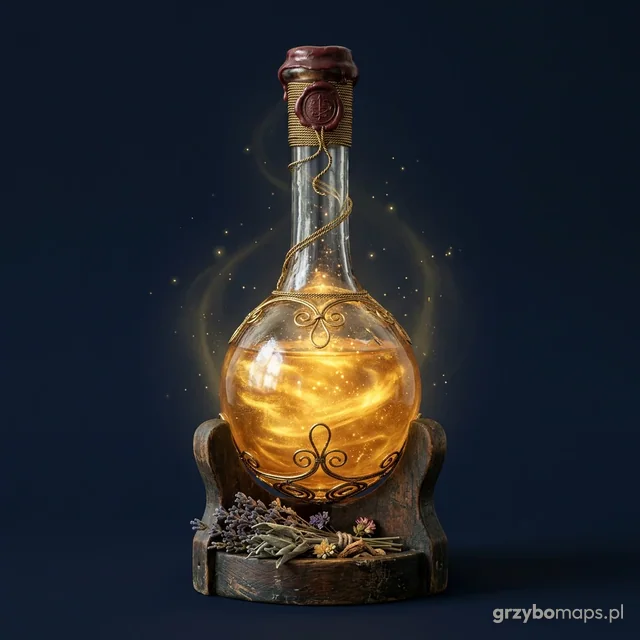
Elixir of life
alchemia
This is how it looks in your profile
This artefact is waiting somewhere in the forest. When you find it while mushroom picking, its animated icon will light up in your Trophies, in the Artefact Display Case. Common artefact gives 5 pts in the league.
A legendary elixir of immortality, said to halt the ageing of whoever drank it. Alchemists sometimes believed that the philosopher’s stone was needed to prepare it.
Origin
The dream of a drink of immortality is ancient: already in the Mesopotamian “Epic of Gilgamesh” the hero seeks the plant of youth, and in China the first emperor Qin Shi Huang (3rd century BC) sought it. The word “elixir” comes from the Arabic “al-iksir”, by which alchemists called the miraculous powder of transmutation, and in medieval Europe it came to mean a remedy for all diseases.
History
Gilgamesh, king of Uruk, begins to fear his own death after the death of his friend Enkidu. From Utnapishtim, survivor of the flood, he learns of a plant that restores youth, growing at the bottom of the sea. He dives for it, but while he is bathing in a spring, a snake steals the plant, sheds its skin and slithers away rejuvenated. Gilgamesh returns home empty-handed.
In India the gods and demons together churned the Ocean of Milk to draw out amrita, the drink of immortality. When the pot appeared, Vishnu in the form of the beautiful Mohini shared out the drink to the gods alone. The demon Rahu drank a sip by trickery, but Vishnu cut off his head, and, according to the myth, the immortal head still chases the Sun and the Moon today, causing eclipses.
In 219 BC the first emperor of China, Qin Shi Huang, sent the magician Xu Fu out to sea, with thousands of boys and girls, to find the immortals of the island of Penglai. Xu Fu came back with excuses, and in the end sailed away and never returned. According to legend he reached Japan. The emperor died in 210 BC, and historians suppose that he was harmed by mercury pills given to him by court alchemists.
In the Chinese myth of Chang'e, the archer Hou Yi receives an elixir of immortality, but his wife Chang'e drinks it and flies away to the Moon, where she lives to this day. In Europe, alchemists sought the elixir, linking it with the philosopher's stone, and physicians such as Paracelsus wrote of remedies that prolong life. No one has produced proof that anyone lived even a single day longer thanks to it.
How it works
According to the alchemists, the elixir cured all diseases, restored youth and protected against death. It was sought in Europe as well as in China and India, where the divine amrita played a similar role.
Powers
- Immortality: According to the legends, whoever drinks the elixir will not die of old age.
- Restoring youth: Gilgamesh's plant and amrita were meant to rejuvenate the body, just as a snake sheds its skin.
- Healing: Alchemists believed that the elixir cures every disease, which is why it was also called the panacea.
- Power of the gods: In Hindu myths, amrita gives the gods the advantage over the demons.
Fate
The elixir has never been found, and attempts to prepare it sometimes ended in poisonings, especially at Chinese courts, where potions with mercury and arsenic were served. In Japan many towns still show alleged tombs or temples of Xu Fu.
In culture
E.T.A. Hoffmann wrote the novel “The Devil's Elixirs” (1815), and Chang'e, the goddess with the elixir, gave her name to the Chinese lunar programme. The motif of the elixir of life returns in role-playing games as an item that restores health.
Fun fact
The first emperor of China, Qin Shi Huang, sent out expeditions to find the elixir of immortality. Historians suppose that it was rather the “miraculous” pills containing mercury that harmed him.