

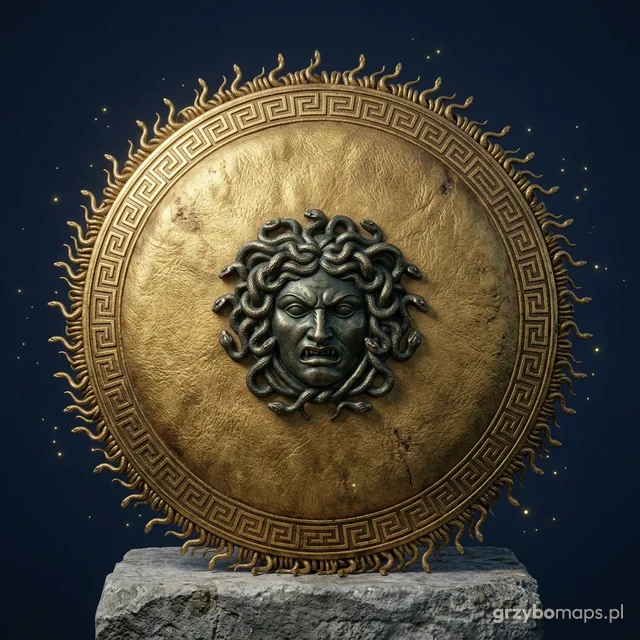
Aegis
mitologia grecka
This is how it looks in your profile
This artefact is waiting somewhere in the forest. When you find it while mushroom picking, its animated icon will light up in your Trophies, in the Artefact Display Case. Legendary artefact gives 50 pts in the league.
A shield or cloak of goatskin, belonging to Zeus and worn by his daughter Athena. In the centre is set the gorgoneion, the head of Medusa, which Perseus presented to Athena.
Origin
The aegis, in Greek aigis, meaning “goatskin”, is in Homer's “Iliad” the weapon of Zeus, forged for him by Hephaestus. Later sources, including Eratosthenes and Hyginus, link it with the skin of the goat Amalthea, and Apollodorus gives yet another version of its origin.
History
Homer describes the aegis as terrible, adorned with a hundred tassels of gold. In the fifth book of the “Iliad” Athena throws it over her shoulders before battle: around it Terror runs like a garland, on it are Strife, Strength and Pursuit, and in the middle the head of the Gorgon, “a dreadful monster, sign of Zeus”. Whoever sees the aegis in motion loses courage.
In the fifteenth book Apollo used the aegis. When he shook it straight in the eyes of the Achaeans and shouted, the Greeks scattered in panic like a herd before two predators, and the Trojans reached as far as the ships. Zeus, for his part, shook the aegis on the summit of Ida, bringing about a storm and lightning.
Where did the aegis come from? According to some, it is the skin of the goat Amalthea, whose milk fed Zeus on Crete, and Zeus used it as a shield in the fight against the Titans. Apollodorus relates that during the Gigantomachy Athena killed the giant Pallas, flayed him and wrapped her body in his skin. Herodotus, for his part, thought that the Greeks took the model for the aegis from Libyan women, who wore goatskins with fringes.
The aegis was given its final shape by Perseus. After killing Medusa he offered her head to Athena, who set it in the middle of the aegis. From then on the Gorgon's gaze, which turned onlookers to stone, was part of the goddess's armour, and the gorgoneion, an image of that head, was placed by the Greeks on shields, gates and roofs to ward off evil.
How it works
According to Homer, when Zeus shakes the aegis, clouds gather over Mount Ida, lightning strikes and panic seizes his enemies. Medusa’s head, even after being cut off, turns to stone anyone who looks at it. In the “Iliad” we read that not even the thunderbolt of Zeus can overcome the aegis.
Powers
- Sowing panic: A shaken aegis fills enemies with fear and forces them to flee.
- Mastery of the storm: In the hands of Zeus it summons clouds, thunder and lightning.
- Impenetrable protection: According to Homer, not even the thunderbolt of Zeus can defeat it.
- The Gorgon's gaze: The head of Medusa on the aegis turns to stone whoever looks at it.
Fate
The aegis as an object remained on Olympus, but its image survived in art. It was worn by the statue of Athena Parthenos by Phidias in the Parthenon, and in Roman times the aegis was added to portraits of emperors as a sign of divine protection.
In culture
From it comes the Polish expression “pod egidą” (“under the aegis”) and the name of the American ship defence system Aegis. The statue of Athena Parthenos with the aegis is known to us today from Roman copies, including the Varvakeion statuette in the National Archaeological Museum in Athens.
Fun fact
Some myths say the aegis was the skin of the goat Amalthea, who nursed the infant Zeus. From it comes the Polish expression “pod egidą” (“under the aegis”), meaning under the protection or patronage of someone.