

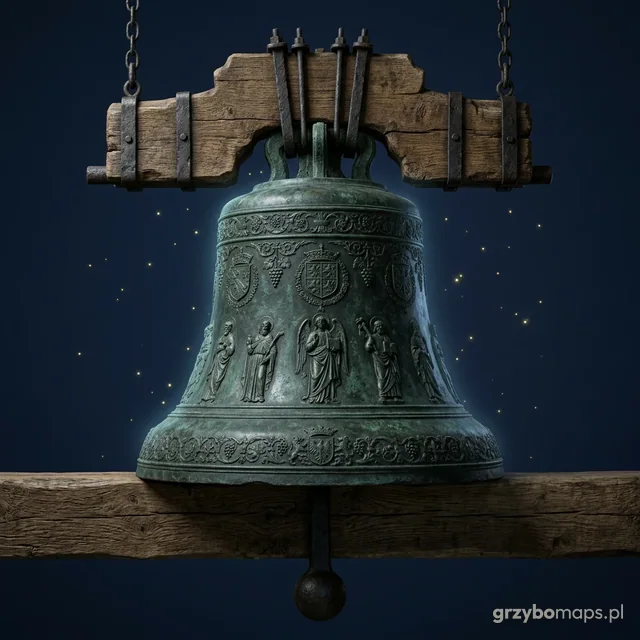
Sigismund Bell
historia polska
This is how it looks in your profile
This artefact is waiting somewhere in the forest. When you find it while mushroom picking, its animated icon will light up in your Trophies, in the Artefact Display Case. Common artefact gives 5 pts in the league.
The most famous Polish bell, endowed by Sigismund the Old and cast in 1520 by Hans Behem, hangs in the Sigismund Tower of Wawel Cathedral. It rings only on the most important holidays and at moments of importance for the country.
Origin
The bell was commissioned by King Sigismund the Old and cast in Kraków in 1520 by the Nuremberg bell-founder Hans Behem. It was hoisted into the tower of Wawel Cathedral on 9 July 1521, and rang for the first time on 13 July 1521.
History
Sigismund the Old wanted a voice worthy of the Jagiellons to resound over Kraków. He ordered a bell from master Hans Behem of Nuremberg, and according to tradition the bronze of cannons captured in the great victory at Orsha in 1514 was also melted down for the casting. The casting weighed almost ten tonnes, which made it one of the largest bells in Europe at the time.
Hauling the colossus up the tower was an event for the whole city. Three centuries later the scene was painted by Jan Matejko in the picture “Hanging of the Sigismund Bell in the Cathedral Tower in 1521”. When the bell struck for the first time on 13 July 1521, all of Kraków heard its voice.
Since then Sigismund rings only at exceptional moments: on great church feasts, at coronations and funerals of kings, on days of important anniversaries and national turning points. It sounded, among other occasions, in 1978 after the election of Karol Wojtyła as pope and in April 2005 after his death.
The bell is so heavy that only a dozen or so experienced bell-ringers can set it swinging. Its iron clapper, weighing 323 kilograms, broke three times in the 19th century. A fourth crack was discovered at Christmas 2000. A new clapper, heavier than the old one, struck for the first time in April 2001.
How it works
According to Kraków tradition, touching the heart of the bell brings luck, and a maiden who does so will soon marry. Only a dozen or so bell-ringers of the Brotherhood of Wawel Bell-Ringers can set the bell swinging.
Powers
- Voice of the nation: According to tradition, Sigismund speaks only at the most important moments for Poland and the Church.
- Luck from the heart: A Kraków tale says that whoever touches the heart of the bell will have good luck.
- A speedy marriage: A maiden who touches Sigismund's heart will, according to tradition, soon marry.
- Bronze from Orsha: According to the tale, the bell was cast with bronze from captured cannons, so it bears the memory of a victory.
Fate
Sigismund still hangs in the Sigismund Tower of Wawel Cathedral and is regularly inspected by specialists. In 2021 the jubilee of the 500th anniversary of its first ringing was solemnly celebrated.
In culture
Jan Matejko's painting of 1874 preserved the scene of its hanging, and the Sigismund Bell is one of the most recognisable symbols of Kraków and of Polish history.
Fun fact
The bronze of cannons captured at the Battle of Orsha in 1514 was reportedly used, among other things, for the casting. On the bell’s mantle is the inscription “HANS BEHAM VON NVRMBERG”.