

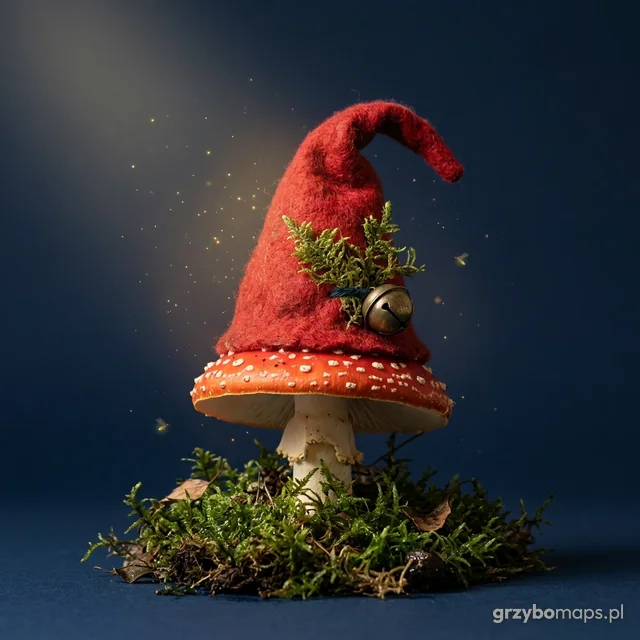
Gnome’s cap
just for fun: Polish fairy tale
This is how it looks in your profile
This artefact is waiting somewhere in the forest. When you find it while mushroom picking, its animated icon will light up in your Trophies, in the Artefact Display Case. Common artefact gives 5 pts in the league.
Gnomes (“krasnoludki”) are usually depicted in pointed red caps, from which they are said to derive their name. The word “krasnoludki” was popularised by Maria Konopnicka in the fairy tale “O krasnoludkach i o sierotce Marysi” (“About the Gnomes and Orphan Mary”).
Origin
Small beings living underground and in forests are known from folk beliefs all over Europe, and in Polish tradition related to them are the household sprites and house spirits. The word “krasnoludki”, linked to the red (“krasna”) colour of their little caps, was popularised by Maria Konopnicka in the fairy tale “O krasnoludkach i o sierotce Marysi” (“Of the Dwarfs and of Little Orphan Mary”), published at the end of 1895.
History
In Konopnicka's fairy tale the dwarfs sleep all winter in underground caves, and when spring comes they go out into the world. They are ruled by King Błystek, and the court chronicler is the scholar Koszałek-Opałek, who writes a great chronicle and keeps falling asleep as he does. The dwarfs wear red caps and are so small that they hide under leaves and mushrooms.
The dwarfs decide to quietly help good people. That is how they come to the poor orphan Marysia, who tends geese for a farmer. When the girl runs into trouble, the dwarf Podziomek comes to her aid with his companions. Together they roam fields and forests, having adventures with people and animals.
People rarely see dwarfs, because they know how to vanish into the grass, and their presence is betrayed by effects rather than by sight: work done, a lost thing found, a corner tidied. In folk beliefs similar beings could repay kindness, but when offended they could also play tricks.
The motif of a cap that grants power is older still than Konopnicka. In Germanic tales dwarfs possessed a cap or cloak of invisibility, and in the medieval “Song of the Nibelungs” Siegfried wins such a cloak from the dwarf Alberich. Polish fairy tales know the cap of invisibility as a magical object that is put on in order to become invisible.
How it works
In Konopnicka’s tale the gnomes spend the winter underground and come out in spring to quietly help good people. They help the poor goose-girl Marysia find her lost goslings, and the human eye rarely catches sight of them.
Powers
- Invisibility: In many fairy tales the cap of a dwarf or gnome allows one to become invisible.
- Helping good people: In Konopnicka's tale, dwarfs in red caps help the poor and honest, such as little orphan Marysia.
- Trademark: The red, pointed little cap is the best-known attribute of the dwarf.
- Mischievous nature: According to folk belief, an offended sprite can make mischief, so it is better to leave it a kind word.
Fate
Gnome caps can still be seen all over Poland. Since 2001 dwarf figurines have been appearing on the streets of Wrocław, now counted in the hundreds, referring to the happenings of the Orange Alternative.
In culture
Konopnicka's fairy tale has seen many editions and film, stage and animated adaptations, and Koszałek-Opałek has become a byword for an absent-minded scholar.
Fun fact
The book was published by Michał Arct just before Christmas 1895, although the title page says 1896. It is one of the most famous Polish literary fairy tales.