

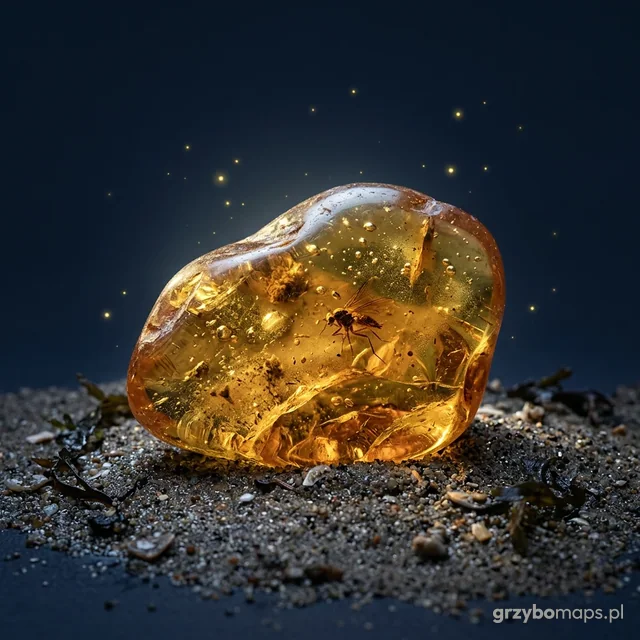
Amber from Jūratė’s palace
Baltic (Lithuanian) legend
This is how it looks in your profile
This artefact is waiting somewhere in the forest. When you find it while mushroom picking, its animated icon will light up in your Trophies, in the Artefact Display Case. Common artefact gives 5 pts in the league.
The goddess Jūratė lived in an amber palace on the floor of the Baltic and fell in love with the fisherman Kastytis, and the jealous Perkūnas destroyed the palace with a thunderbolt. The fragments of amber on the beaches are said to be its remains; the legend was recorded in 1842 by Ludwik Adam Jucewicz.
Origin
The legend of Jūratė, queen of the Baltic, was published in Polish by the Samogitian ethnographer Ludwik Adam Jucewicz in 1842 as a tale from the coast of Samogitia. Scholars today believe that it is rather a literary work inspired by folk beliefs about the thunder god Perkūnas than an authentic ancient myth.
History
On the bottom of the Baltic, in a palace of pure amber, lived the goddess Jūratė. The thunder god Perkūnas had destined her to be the wife of the water god Patrimpas, and entrusted her with guarding the sea and its fish. One day it was reported to her that a young fisherman from the mouth of the Šventoji, Kastytis, was casting his nets in her waters and fishing without restraint.
Jūratė swam out with a retinue of mermaids to punish him, but when she saw him, she fell in love. Instead of revenge there was love: Jūratė took Kastytis to her amber palace and they spent whole nights together. The goddess, who had been promised to another, forgot all warnings.
Perkūnas learned of everything. Enraged that an immortal goddess had fallen in love with an ordinary mortal, he hurled a thunderbolt into the sea. The amber palace shattered into thousands of pieces, Kastytis died, and Jūratė was chained to the ruins of her home on the sea floor.
Since then, when a storm rages on the Baltic, the waves cast fragments of the amber palace onto the shore. The larger lumps are remnants of the walls, and the small, transparent droplets are the tears of Jūratė, who still mourns her beloved. In another version, told around Palanga, the roles are reversed: it was Jūratė who died by the ruins, and Kastytis remained chained forever on the sea floor.
How it works
According to the legend, Jūratė ruled the Baltic from an amber palace on the sea floor. When she fell in love with a mortal fisherman, the angry Perkūnas shattered the palace with a thunderbolt and killed Kastytis. The waves still throw fragments of the palace onto the shore, and in some versions they are the tears of the goddess mourning her beloved.
Powers
- A fragment of the palace: According to the legend, every piece of amber is a particle of the goddess's destroyed underwater palace.
- Tears of the goddess: The smallest, transparent grains of amber are said to be the petrified tears of Jūratė.
- Dominion over the sea: The palace was the seat of the ruler of the Baltic and its fish.
- Healing power (folk belief): Regardless of the legend, amber has been worn for centuries as an amulet protecting against illness, although science does not confirm this.
Fate
According to the legend, the palace will never be rebuilt, and the sea keeps casting up its fragments. In reality, Baltic amber is fossilised tree resin from tens of millions of years ago, and the largest collections can be seen in the Amber Museum in Palanga and the Amber Museum in Gdańsk, among others.
In culture
The name of the seaside town of Jurata on the Hel Peninsula comes from the goddess's name. In Lithuania the legend was popularised by Maironis's ballad “Jūratė ir Kastytis” of 1920, and in Palanga there stands a sculpture depicting the lovers.
Fun fact
The Amber Museum has operated since 1963 in the Tyszkiewicz Palace in Palanga, Lithuania. Its collection numbers about 28 thousand specimens, many of them with insects and plants trapped in the resin.