

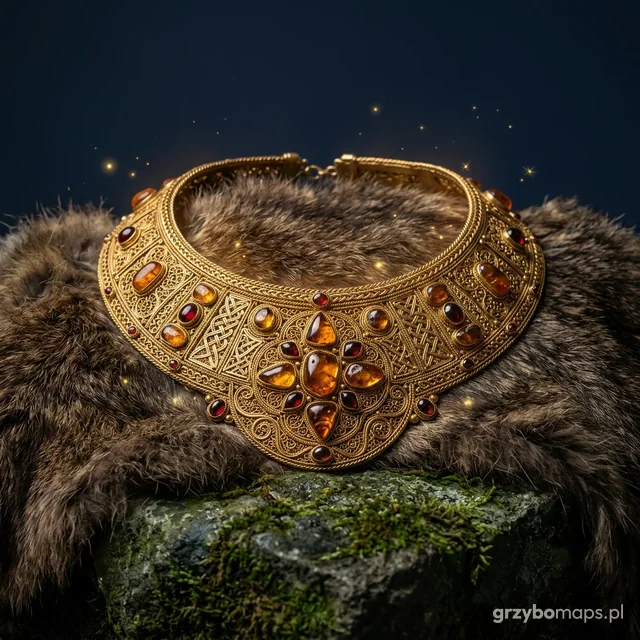
Brisingamen
mitologia nordycka
This is how it looks in your profile
This artefact is waiting somewhere in the forest. When you find it while mushroom picking, its animated icon will light up in your Trophies, in the Artefact Display Case. Rare artefact gives 15 pts in the league.
The gleaming necklace of the goddess Freya, made by four dwarves called the Brisings. Freya desired it greatly and paid a high price for it.
Origin
Brisingamen is the necklace of the goddess Freyja, and its name probably means “jewel of the Brisings”. It is mentioned in the “Poetic Edda” (including the “Lay of Thrym”), by Snorri Sturluson in the “Prose Edda” (c. 1220), and in the late Icelandic tale “Sörla þáttr” from the 14th-century manuscript Flateyjarbók, which describes how four dwarves forged it.
History
According to “Sörla þáttr”, Freyja once came to the stone workshop of four dwarves: Alfrigg, Dvalin, Berling and Grer. They were just forging a golden necklace so beautiful that the goddess desired it at first sight. She offered silver and gold, but the dwarves wanted a different payment: that she spend a night with each of them. Freyja agreed and returned with the jewel.
Loki told Odin about this, and Odin ordered him to get the necklace. Loki turned into a flea, slipped into Freyja's locked bedroom and bit her on the cheek so that she would turn over onto her side. Then he undid the clasp and escaped. Odin returned the jewel only on the condition that Freyja stir up an eternal war between two kings, Hedin and Högni, whose fallen warriors rise every morning to fight on.
In another version, known to Snorri from the skaldic poem “Húsdrápa” (end of the 10th century), the necklace stolen by Loki was recovered by Heimdall. The two gods turned into seals and fought at the skerry Singasteinn, and Heimdall returned with the jewel. It is one of the oldest foreshadowings of their final duel at Ragnarök.
In the “Lay of Thrym”, the giant demands Freyja as his wife in return for Thor's hammer. The goddess flies into such a rage that the dwelling of the gods trembles and Brisingamen bursts on her neck. Instead of her, Thor goes to the wedding in disguise and it is he who puts on the famous necklace, so that the giants believe they are seeing Freyja.
How it works
In the “Lay of Thrym”, Freya grows so angry that Brisingamen bursts on her neck, and her rage shakes the dwelling of the gods. According to Snorri, Loki stole the necklace, and Heimdall fought him in the form of seals and recovered the jewel.
Powers
- Freyja's emblem: The necklace was so bound to the goddess that Thor, wearing it, passed for her in the eyes of the giants.
- An irresistible jewel: Its beauty made even the goddess agree to any price.
- Cause of wars: In “Sörla þáttr”, the price for its return is the eternal battle of the kings Hedin and Högni.
- Radiant glow: The name is often translated as “shining, flaming jewel”, which points to its dazzling gleam.
Fate
In the myths the necklace always returns to Freyja, and its further fate is not described. The Old English “Beowulf” mentions the Brosinga mene, which the hero Hama carried off from the Gothic king Ermanaric, showing that the tale was known far beyond Scandinavia.
In culture
The necklace gave its title to Alan Garner's fantasy novel “The Weirdstone of Brisingamen” (1960), and the word “brisingr”, “fire”, became a spell and the title of a volume of Christopher Paolini's “Inheritance” cycle.
Fun fact
The necklace also appears in the Old English poem “Beowulf” as “Brosinga mene”, one of the few mentions of it from outside Scandinavia.