

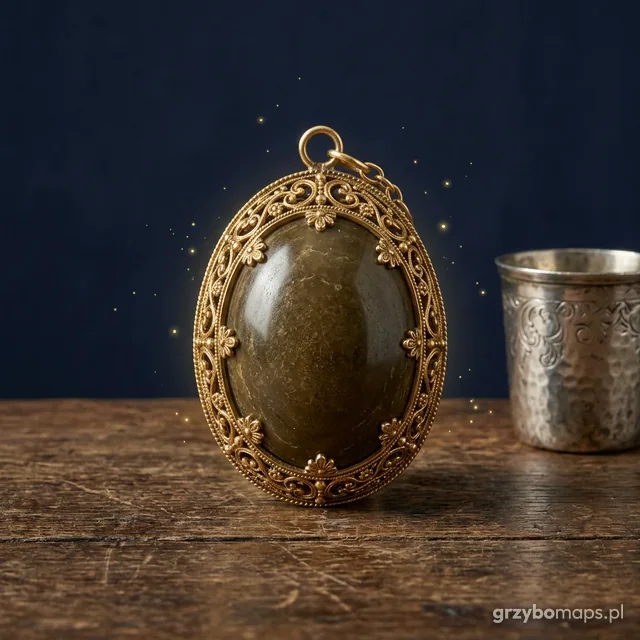
Bezoar
dawna medycyna
This is how it looks in your profile
This artefact is waiting somewhere in the forest. When you find it while mushroom picking, its animated icon will light up in your Trophies, in the Artefact Display Case. Common artefact gives 5 pts in the league.
A stone that forms in the stomachs of animals, such as goats, from compacted hair and undigested remains. The name comes from Persian and means “antidote”.
Origin
Bezoars are hard masses of hair, plant fibres and mineral salts that form in the stomachs of animals, the most famous in the stomachs of wild goats from Persia. The name comes from the Persian “pād-zahr”, meaning “against poison”. Knowledge of their healing power reached Europe in the Middle Ages with Arabic medicine.
History
Arab and Persian physicians considered the bezoar nature's noblest antidote. According to belief, animals that ate poisonous plants and did not die carried within them a remedy that protected them. The stone was set in gold, hung on chains and dipped in wine before a meal, or powder was scraped from it.
At European courts the bezoar became a jewel as valuable as the unicorn's horn. Rulers received them as gifts, kept them in treasuries and carried them on their person just in case. In the Habsburg collections, goblets with bezoars in gold mountings have survived.
The French surgeon Ambroise Paré, who served King Charles IX, had doubts. When the king received a bezoar, Paré proposed a test. A cook condemned to death for stealing silverware agreed to take poison, and then the bezoar, in exchange for a pardon if he survived. He died after a few hours in agony, and Paré declared that the bezoar is not an antidote to all poisons.
Even so, demand continued for another century. In the 17th century, Jesuits in Portuguese Goa made artificial “Goa stones” from clay, shells, musk and gold, sold as a cheaper equivalent. Physicians finally abandoned the bezoar in the 18th century, when the development of chemistry and pharmacology took away its credibility.
How it works
In old medicine it was thought that a bezoar would neutralise any poison. Monarchs had it set in gold and kept it in their treasuries, and it was soaked in drinks as protection against being poisoned.
Powers
- Universal antidote: According to old medicine, a bezoar dropped into a goblet neutralised any poison.
- Protection of the wearer: Worn as an amulet, it was meant to protect against poisoning and plague.
- Medicine from powder: The scraped powder was given for fevers and illnesses, which today is considered ineffective.
- Proof of rarity: A genuine bezoar was so rare that merely owning one brought its owner prestige.
Fate
Bezoars set in gold are kept today by museums, including the Kunsthistorisches Museum in Vienna. In medicine, the word “bezoar” today means masses of undigested substances in the human stomach, which sometimes have to be removed surgically.
In culture
In the Harry Potter novels, Snape teaches that a bezoar from a goat's stomach protects against most poisons, and Harry uses one to save Ron in “The Half-Blood Prince” (2005). It is a fictional development of the old belief.
Fun fact
In 1567 the French surgeon Ambroise Paré tested this belief on a condemned cook who agreed to take a poison and a bezoar. The stone did not help, and Paré declared that it is not an antidote for everything.