

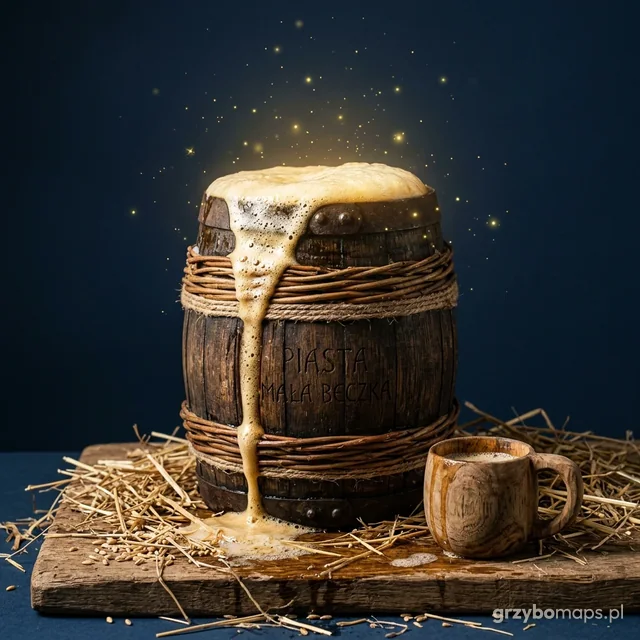
Piast’s little barrel
Polish legend (Gallus Anonymus)
This is how it looks in your profile
This artefact is waiting somewhere in the forest. When you find it while mushroom picking, its animated icon will light up in your Trophies, in the Artefact Display Case. Rare artefact gives 15 pts in the league.
According to the chronicle of Gallus Anonymus, the poor ploughman Piast and his wife Rzepicha hosted two wanderers whom Prince Popiel had driven away from his feast. For his son’s hair-cutting celebration Piast had prepared only a small barrel of beer, and yet there was enough for everyone.
Origin
The story was recorded by Gallus Anonymus in the first Polish chronicle, written at the beginning of the 12th century. Gallus states that Piast was the son of Chościsko and that his wife was named Rzepka, in later tradition Rzepicha. The epithet “the Wheelwright” was added to Piast only by later tradition.
History
Duke Popiel ruled in Gniezno. He was just holding a great feast for the tonsure of his sons, that is, the old rite in which a boy had his hair cut for the first time and was given his name. Two unknown wanderers came to the stronghold, but instead of hospitality they met with insults and were driven away.
The wanderers found their way to the hut of the poor ploughman Piast, who was also preparing the tonsure of his son. Piast and Rzepka welcomed them warmly, though they had little: a small barrel of beer and a piglet. The guests told them to pour boldly. The beer kept increasing until all the vessels borrowed from the neighbours were filled, and the meat did not diminish.
Then the wanderers cut the boy's hair and gave him the name Siemowit. Meanwhile, at Popiel's, the vessels suddenly ran empty.
According to Gallus, Siemowit grew into a brave man and became duke, and Popiel was driven out of the country. The chronicler adds that Popiel was overtaken by mice. Later chroniclers, especially Wincenty Kadłubek, expanded this thread into the famous tale of the mice that devoured the cruel duke, according to tradition in a tower on Lake Gopło in Kruszwica. The mysterious guests were identified by later tradition with angels or saints.
How it works
According to the chronicle, the guests told Piast to keep pouring calmly, and the beer kept increasing until all the borrowed vessels were filled with it. The meat of the piglet did not run out either. The miracle befell those who were hospitable, while at Popiel’s the vessels stood empty.
Powers
- Never-ending beer: According to the chronicle, the beer in the barrel kept increasing, however much needed to be poured.
- Reward for hospitality: The miracle befell those who welcomed the wanderers, while the miserly duke lost his supplies.
- Blessing of the dynasty: Siemowit's tonsure in Piast's hut foretold the birth of the Piast dynasty.
- Multiplied food: Along with the beer, the meat of the piglet miraculously did not run out either.
Fate
The barrel was lost in the mists of legend, but the dynasty it gave rise to ruled Poland until 1370, and in Silesia and Mazovia even longer. The last Silesian Piast died in 1675.
In culture
The legend was popularised by Józef Ignacy Kraszewski's novel “Stara baśń” (“An Ancient Tale”, 1876), adapted for the screen by Jerzy Hoffman in 2003. The word “piastowski” (“Piast-like”) still means something ancient and quintessentially Polish.
Fun fact
The chronicle of Gallus Anonymus, written at the beginning of the 12th century, is the oldest Polish chronicle. Piast’s son, Siemowit, was to become prince of the Polans after the overthrow of Popiel.