

The Ark of the Covenant
The Bible (Old Testament)
This is how it looks in your profile
This artefact is waiting somewhere in the forest. When you find it while mushroom picking, its animated icon will light up in your Trophies, in the Artefact Display Case. Legendary artefact gives 50 pts in the league.
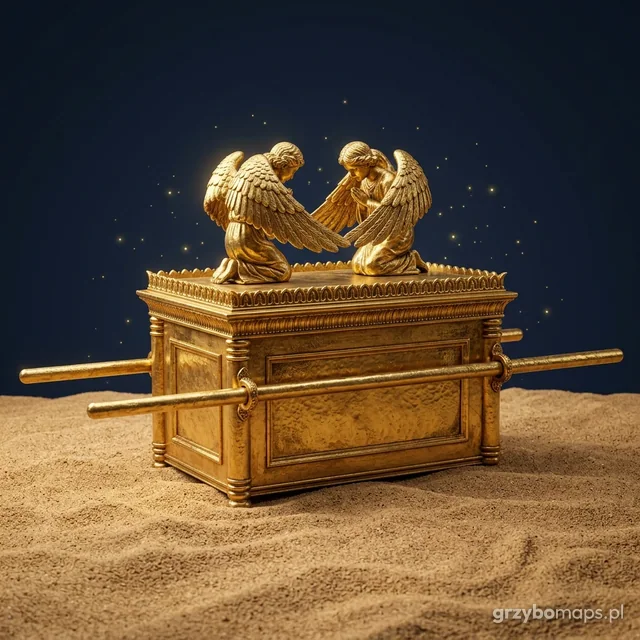
A chest of acacia wood overlaid with gold, with two golden cherubim on its lid, in which the stone tablets of the Decalogue were kept. Its later fate is unknown, and it is considered lost.
Origin
According to the Book of Exodus, God himself gave Moses the exact dimensions and appearance of the Ark on Mount Sinai, and it was made by the inspired craftsman Bezalel. Descriptions of the Ark appear in the Books of Exodus, Numbers, Joshua, Samuel and Kings, written down in the 1st millennium BC.
History
The Ark was about two and a half cubits long, and on its golden lid, called the mercy seat, two cherubim knelt with outstretched wings. According to biblical tradition, it was from between them that God spoke to Moses. Inside lay the stone tablets of the Law, and the Letter to the Hebrews adds a golden jar of manna and Aaron's rod that had budded.
The Ark went at the head of Israel through the desert. When the priests carried it into the current of the Jordan, the water stood up like a wall and the people crossed on dry ground into the Promised Land. At Jericho the priests carried it around the walls for seven days; on the seventh day the trumpets sounded and the walls fell.
The most extraordinary episode is described in the First Book of Samuel. After the defeat at Ebenezer, the Philistines captured the Ark and placed it in the temple of the god Dagon in Ashdod. In the morning the statue of Dagon lay face down on the ground, and the inhabitants of one city after another were struck by plagues. Terrified, the Philistines sent the Ark back on a cart drawn by two cows, which took it by themselves to Beth-shemesh.
The Ark also inspired fear. When King David was bringing it to Jerusalem, the cart lurched, and Uzzah, who touched it with his hand to steady it, fell dead. Later David danced before the Ark for joy as it was carried into the city. His son Solomon placed it in the Holy of Holies of the Temple he had built.
After that the trail goes cold. The Bible does not describe its destruction or removal when the Babylonians destroyed the Temple in 587 or 586 BC. The Second Book of Maccabees preserves a tradition that the prophet Jeremiah hid it in a cave on Mount Nebo, and that the place will remain unknown until God once again gathers his people.
How it works
According to the Bible, the Ark was a sign of God's presence among the Israelites. It was carried on poles and no one was allowed to touch it. When the priests carried it to the Jordan, the waters of the river stopped, and at Jericho it was carried around the walls for seven days.
Powers
- Sign of God's presence: In biblical tradition, God spoke to Moses from between the cherubim on the lid.
- Stopping the waters: When the priests carrying the Ark entered the Jordan, the river stopped and the people crossed over the dry riverbed.
- Inviolability: Whoever touched the Ark without authorization died, like Uzzah in David's time.
- Plagues upon enemies: Among the Philistines, the statue of Dagon fell before the Ark, and the cities that held it were struck by plagues.
- Guide of the people: The Ark went at the head of the march through the desert and of the armies of Israel.
Fate
The Ark was lost at the latest when the First Temple was destroyed, and to this day no one knows what became of it. The Ethiopian book “Kebra Nagast” tells that Menelik, son of Solomon and the Queen of Sheba, took it to Ethiopia. Today the Ethiopian Church points to a chapel in Axum, which only one guardian monk may enter, and no outsider may see it.
In culture
The most famous echo of the Ark in culture is Steven Spielberg's 1981 film “Raiders of the Lost Ark”, the first adventure of Indiana Jones.
Fun fact
The Ethiopian Orthodox Church claims that the Ark rests in a chapel in Aksum. Every church in Ethiopia has a symbolic copy of it, called a tabot.